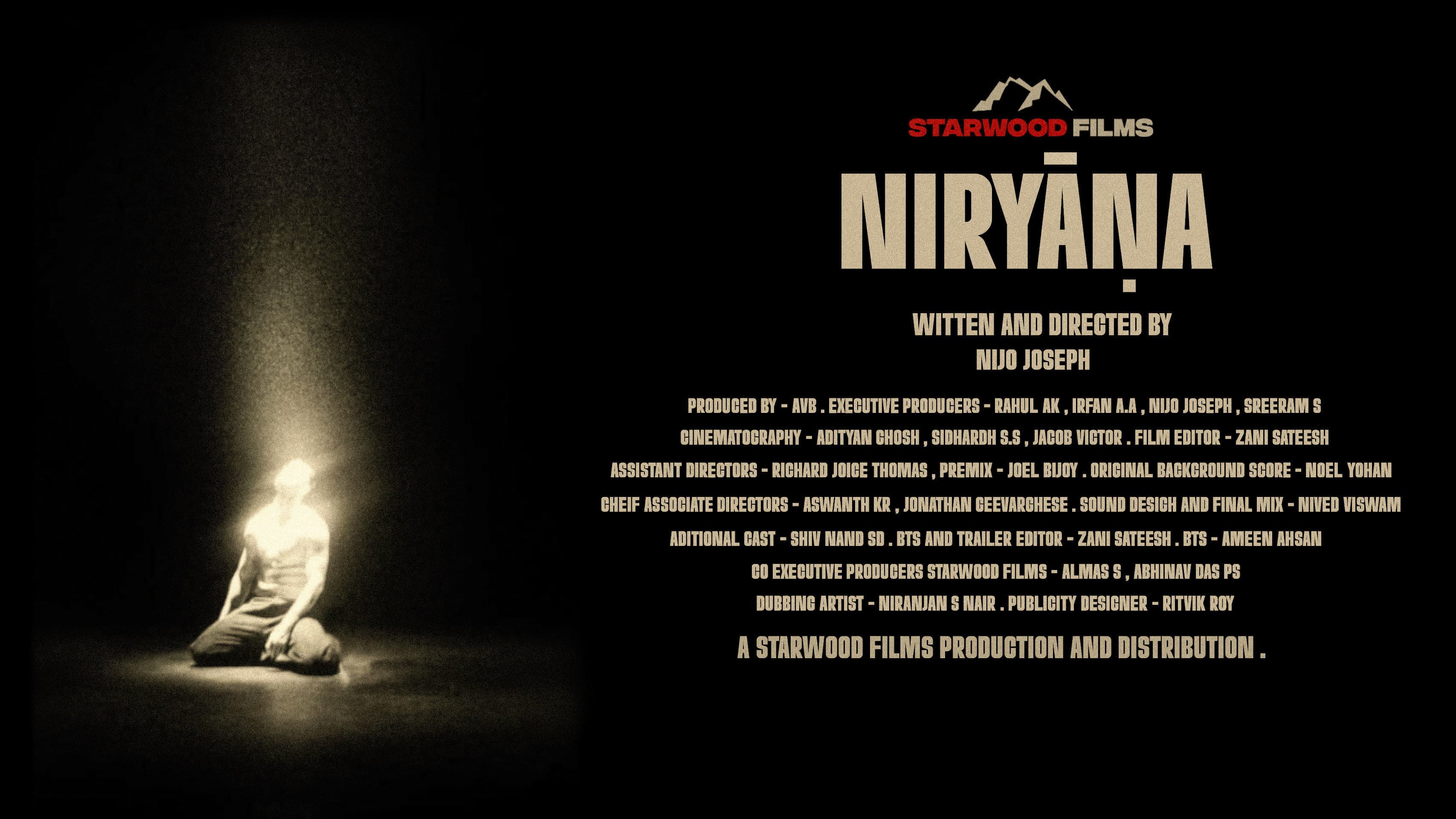
Six minutes. That is all Nijo Joseph asks of an audience. In an era when Malayalam cinema is routinely pushing past the two-and-a-half-hour mark, his experimental psychological thriller Niryana arrives as a deliberate act of compression - a brief, black-and-white plunge into the space between the last breath and whatever waits on the other side. Released on September 18, 2026, the film has since become something of a quiet obsession among viewers drawn to the outer edges of the medium.
Niryana unfolds in Varanasi, that most timeless of spiritual landscapes, where the sacred and the profane have shared the same narrow lanes for centuries. A wandering soul finds itself caught between memory and existence, unable to move forward, unwilling to let go. What follows is less a conventional narrative than a descent - through fragments of a forgotten past, encounters with a mysterious mythical presence, and the slow erosion of any stable sense of reality. The film draws deeply on Hindu mythology, Sanskrit traditions and the philosophy of karma, treating these not as decoration but as the very architecture of its story.
The director, Nijo Joseph, also carries the film on screen alongside Shiv Nand SD, a two-hander that keeps the focus tight and the tension intimate. Joseph's approach is austere to the point of provocation: stark black and white, an intense interplay of light and shadow, and a runtime so short it functions almost as a prose poem. Shadows in Niryana do as much storytelling as the faces. Light falls in slivers. Darkness swallows the frame's corners. It is a formal choice that mirrors the film's central preoccupation - the fragile boundary between life, death and liberation - where nothing is fully illuminated and nothing is entirely lost.
The film's engagement with death is neither morbid nor sentimental. Instead, Niryana treats mortality as a philosophical problem, one rooted in the idea that karma binds a soul to cycles it cannot see. Its wandering protagonist is less a character than a condition: a consciousness suspended, replaying memory without context, meeting myth face to face and finding no comfort there. As the film progresses, reality itself begins to lose its meaning - a disorientation the director sustains without ever tipping into chaos.
Upon release, Niryana found a devoted following, and its reception has been striking. The film currently holds a rare 10/10 rating on TMDb, a figure that speaks to the intensity of its admirers even as it reflects the kind of polarised attention experimental work tends to attract. Few films of any length provoke such devotion; fewer still do so in six minutes.
What makes Niryana notable within Malayalam cinema is not merely its brevity but its refusal of the familiar. Mollywood has long been a home for formally ambitious work, yet the psychological thriller space is usually occupied by longer, plot-driven constructions. Joseph's film instead offers an exploration of what lies beyond the final breath, staged with the discipline of an art installation and the philosophical seriousness of a text. It asks the audience to sit with ambiguity rather than resolve it.
Whether Niryana signals a broader appetite for micro-length experimental cinema in Malayalam remains to be seen. What is clear is that the film has carved a small, strange space for itself - one where myth, memory, mortality and the unknown converge in monochrome. Six minutes, an eternity's worth of questions. For now, that seems to be enough.