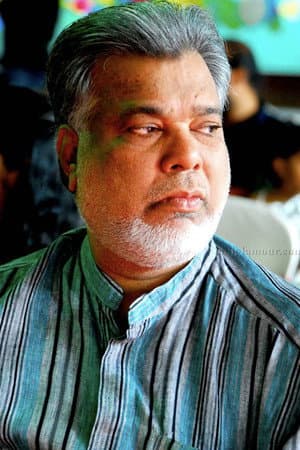
Saikumar, also credited as Sai Kumar, is a performer whose career offers a useful map of Malayalam cinema. The industry term to know first is "credit": the name that appears on screen for a performer in a given film. One body of work appearing under two spellings says something about how Malayalam cinema records its own. Films are catalogued by title, year and credited name, and small variations accumulate across decades. For a reader building a picture of the industry from outside the region, Saikumar is a name worth knowing because the credits show range rather than a single register.
His biography notes that he is the son of the Malayalam performer Kottarakkara Sreedharan Nair, and describes him as one of the most versatile performers in the industry. Versatility here is not a slogan. The confirmed filmography moves between comedy, suspense, political drama and family portraiture without the performer changing register to signal the shift.
The Films and What Each Added
Start with Ramji Rao Speaking (1989), where Saikumar is credited as Balakrishnan. A performer's early credit in a well known comedy is a reminder that careers are built in stages. The comic instinct shown there is no detour from the serious work. It is a foundation under it.
Twenty 20 (2008) casts him as "Minister" Mathai, a role that places him inside the machinery of public life. IG: Inspector General (2009) follows with Beerankutty Sahib, and Manikyakallu (2011) with AEO. Across three years the credits move from legislature to law and order to education administration. These are roles of office: people who hold a position and whose decisions ripple outward. Manikyakallu is worth pausing on because the film's setting is a school, which places the role inside an institution that shapes young lives. The performer's job in such parts is to be the structure the story pushes against.
Mr. Fraud (2014) credits him as Sajan IPS, continuing the law and order thread. Paulettante Veedu (2016) is a study of Paulettan, a Thrissur businessman who built everything from nothing and became a miser whose thrift bears down hardest on his mother Thressiamma, his wife Rosamma and their daughters Sara and Sneha. When Sara falls in love with Amal, the son of a Gulf Malayali, her choice becomes a revolt against her father's thrifty behaviour. This is a family portrait and a character study at once, and it shows the performer carrying a household's weight.
Mr. & Ms. Rowdy (2019) returns him to comedy. Oru Anweshanathinte Thudakkam (2024) casts him as Bishop in a suspense story about an investigating journalist who disappears in Kerala, prompting an investigation that uncovers unexpected mysteries. A role of faith in a film about a disappearance suggests how comfortably the filmography moves between the sacred and the investigative.
The most recent credits cluster in 2025 and 2026. L2: Empuraan (2025) casts him as Mahesha Varma. Madhuvidhu (2026) gives him Markose, in a story where Amrutharaj, a groom from an all-male household repeatedly rejected by brides' families, falls for Sneha Marcose and the road to marriage ignites chaos in his unruly home. Thudakkam (2026) credits him as Ravi. Prathichaya (2026) casts him as Jayadevan, in a story where Kerala's Chief Minister dies in a scandal engineered by a ruthless media tycoon and his son, a technology entrepreneur, enters politics to expose the conspiracy and turn technology against those who weaponised it.
What the Roles Share
Read together, the credits show a performer who is comfortable as an institution. Ministers, officers, bishops, businessmen and fathers recur. These are parts where a single decision carries consequence for a family or a state, and the performer's work is to make authority feel like a person rather than a title. The comedy credits matter here too. A performer who can be funny in one film and a bishop in another is doing the same job in both: finding the human being inside the position. That is what "versatile" means in practice.
For a reader outside the region, the reason to know the name is scale. Malayalam cinema produces films of remarkable tonal range, and Saikumar's credits are a cross section of it: a 1989 comedy, a 2016 family portrait, a 2024 suspense film, a political drama in Prathichaya. Following a single credited name across those titles is a way to see how the industry's genres overlap. The two spellings are not an error to correct but part of the record. A filmography is a body of work, and this one has range enough to be a starting point for anyone learning how Malayalam cinema works. For background on the wider industry, see the Malayalam cinema overview and the Internet Movie Database entry for cross checking credited names.