Kayadu Lohar: A Career In Malayalam Cinema is best read as a study in range. Four Malayalam titles carry her name, and no two ask the same thing of her. One is a 19th century reform drama. One is a palmistry-driven comedy. One is a late-1950s political story. One is a gambler's caper. The through line is variety rather than repetition, and that variety is the point.
Her feature debut came in Kannada cinema with Mugilpete (2021). Since then her work has moved across Kannada, Malayalam, Telugu and Tamil. That mobility says something about craft. Here is a performer who can be trusted inside different languages, different production cultures and different genres. Several of those titles are period films, meaning stories set in a past era, costumed and designed to that time. Others are contemporary comedies built on talk and timing. Both demand discipline. They demand different kinds.
So what connects these choices, and what does each role add to the picture? The answer sits in the films themselves.
The Malayalam Films, One By One
Pathonpatham Noottandu (2022): Nangeli
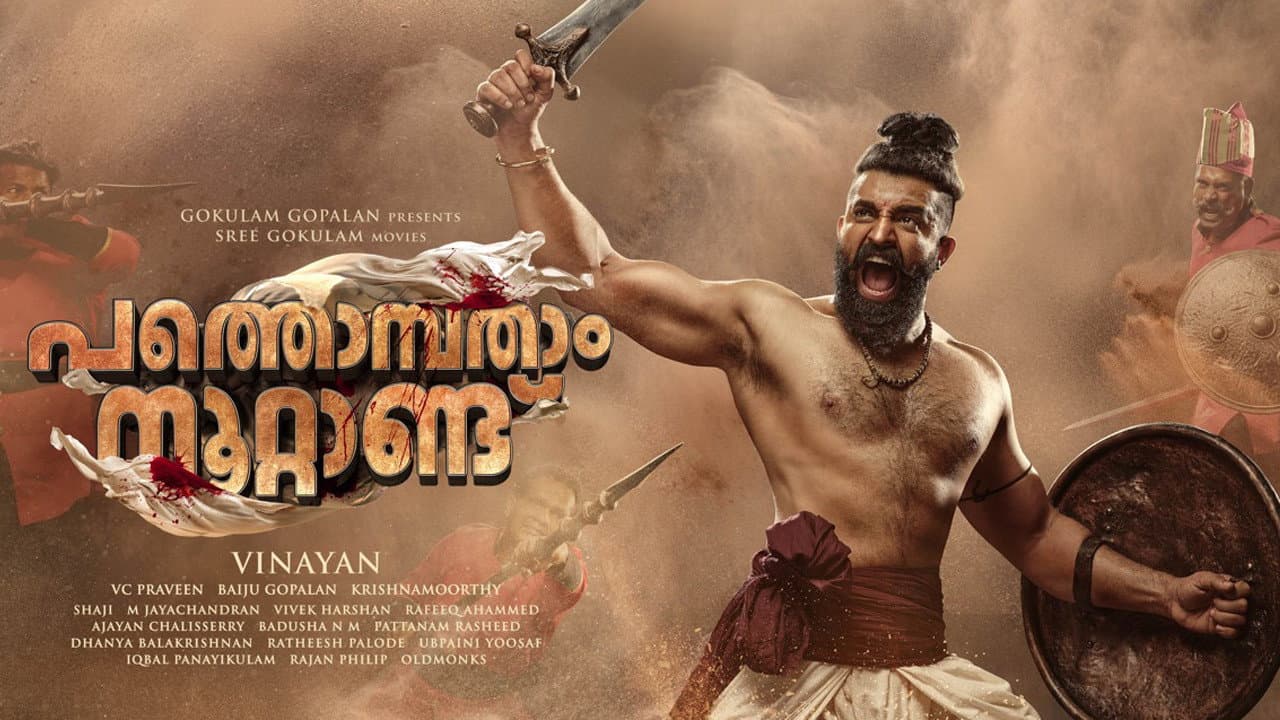
Her first Malayalam film, and the one that set the bar. The story belongs to Arattupuzha Velayudha Panicker, a 19th century social reformer, and his unswerving fight against the caste oppressions imposed by the upper classes. Playing Nangeli placed her inside a historical drama built on social conflict, a very different register from the comedies that follow. Historical roles ask for period-specific body language: how a person stands, walks and holds the eyes in a world with different rules of deference and defiance. That is the foundation role in her Malayalam slate. Everything after it reads as a deliberate change of key.
Oru Jaathi Jaathakam (2025): Payal
A tonal shift, and a sharp one. The premise turns on a girl who presents herself as an expert in palmistry. She asks Jayesh to show his hand, and he eagerly obliges. Then she tells him the coming time will be his worst, which surprises him. Payal is the entry point into how comedy works in Malayalam cinema, where humour often carries social observation inside it: jokes about belief, family expectation and the small negotiations of ordinary life. The film also shows how an ensemble functions, meaning a cast of several leading roles sharing screen time. Comedy of this kind lives on timing, and timing is a craft skill as exacting as any period posture.
Pallichattambi (2026): KPAC Rebecca
The most politically textured of the four. Set in the late 1950s, the film follows Krishnan Pillai, a playful ruffian chosen by the Church to lead a defensive force called the Christopher Sena. His mission to resist the Communist government takes a detour when he experiences an ideological awakening and falls in love with a comrade, meaning a fellow member of a political movement. KPAC Rebecca sits inside that arc as a character caught between rebellion and feudal power. The role asks for something beyond costume: an understanding of ideology as character motivation, of why people choose sides when choosing is dangerous.
I'm Game (2026): Isha
The lightest note. The premise follows a fearless gambler who trusts luck more than life and is caught in a series of crazy, unexpected events that turn his world upside down. Isha shows how a supporting part fits into a caper built around a single reckless lead. In this kind of film the surrounding characters provide the pressure and the counterweight. The comedy depends on how cleanly they land their moments. After the historical drama and the political story, this is the release valve.
A Short Note On The Wider Slate
Alongside the Malayalam titles, the same span includes Telugu work (Alluri in 2022, Funky and The Paradise in 2026) and Tamil work (Dragon in 2025, Idhayam Murali and Immortal in 2026). The point is range across industries, stated once, without ranking or evaluating the other-language films. For background on the regional industries, the Wikipedia entry on Malayalam cinema covers the broad landscape.
Where She Sits, And Why Readers Outside Kerala Should Know The Name
The argument has to come from the work, not from reputation. She moves between historical drama, social comedy and political period storytelling, and each requires a different discipline. Historical roles demand period-specific body language. Comedy demands timing. Political drama demands an understanding of ideology as character motivation. Few bodies of work make those three demands visible side by side so quickly.