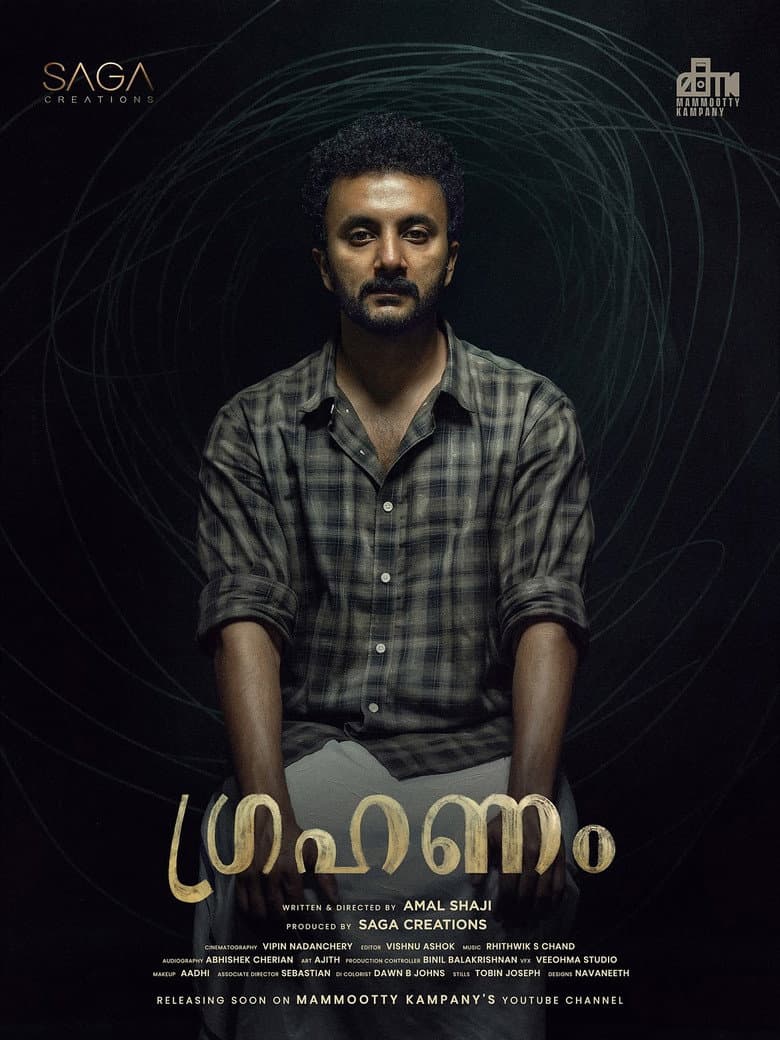
The most unsettling conversations are rarely the loudest ones. They unfold in quiet rooms, across modest tables, between two people who may not be telling each other the truth. That is the terrain Amal Shaji stakes out in Grahanam, a twelve-minute psychological thriller that arrived in Malayalam cinemas on November 13 and has spent its first week quietly burrowing into the heads of the viewers who have sought it out. The film centres on Deepan, played by Siva Ajayan, and the psychiatrist he sits down with, portrayed by Sajeev Kumar. What begins as a routine session - the kind of exchange that could pass for admin work in a lesser film - gradually reveals itself as something far more slippery, a conversation staged for a cause that nobody in the room seems willing to name outright.
The premise is deceptively simple, and that is precisely its weapon. Shaji, directing from what is clearly a tightly controlled conception of the material, resists the urge to open the story outward. Instead he keeps the camera close and the exchanges closer, letting the audience do the work of figuring out who holds the upper hand at any given moment. The genres the film carries - crime, drama, horror, thriller - are not tossed in as decoration. Watching two men talk, with the floor shifting beneath both of them, it becomes clear that the horror here is existential rather than supernatural, and the crime, whatever it turns out to be, is being excavated rather than staged.
Ajayan's work as Deepan carries the weight of the piece. The character requires a performer who can hold a surface of composure while something more turbulent moves underneath, and by all accounts the actor leans into that tension rather than playing it broadly. Opposite him, Sajeev Kumar's psychologist is the film's steadying presence - or appears to be, which is not the same thing. The dynamic between the two men is the engine of the entire twelve minutes, and it is to the director's credit that he trusts his cast to sustain it without the crutch of flashy incident.
Around this central pair, the supporting ensemble sketches a world that exists outside the consultation room. Vivek Anirudh appears as Deepan's brother, a presence that hints at a life beyond the session, while Sanjay Shaji steps in as Madathil Shankaran and Anu Varghese rounds out the cast as a police constable. That a constable figures in a story this intimate tells you something about where the narrative is headed, and that a figure named Shankaran carries weight in the margins suggests Shaji has built more scaffolding than a twelve-minute runtime would ordinarily accommodate. The film, in other words, is small by design but not slight in construction.
Grahanam arrives at an interesting moment for Malayalam short-form filmmaking, which continues to use limited runtimes to test ideas that would buckle under the demands of a conventional feature. Shaji's film is not chasing scale. It is chasing the precise moment when a conversation stops being a conversation and becomes something else entirely - a confession, an interrogation, a trap. The title, which translates to eclipse, is apt: this is a story about what happens when something bright and ordinary is temporarily swallowed by shadow, and about who benefits from the darkness while it lasts.
The film is currently playing with no aggregated audience rating on record yet, which is unsurprising for a release this size and this new. But the early conversation around it suggests a title that will travel by word of mouth rather than by marketing, passed between viewers who want to discuss what they just watched and, more pointedly, what they think they saw. That kind of ambiguity is a choice, not an accident, and it places Grahanam in the company of thrillers that treat their audiences as participants rather than passengers.
For viewers who track Malayalam cinema's smaller exports, this is a name to note - a director working with discipline, a cast working with restraint, and a premise that refuses to explain itself too quickly. Twelve minutes is a short time to leave a mark. Whether Grahanam manages it is the question audiences will be answering in the weeks to come, one hushed post-screening argument at a time.