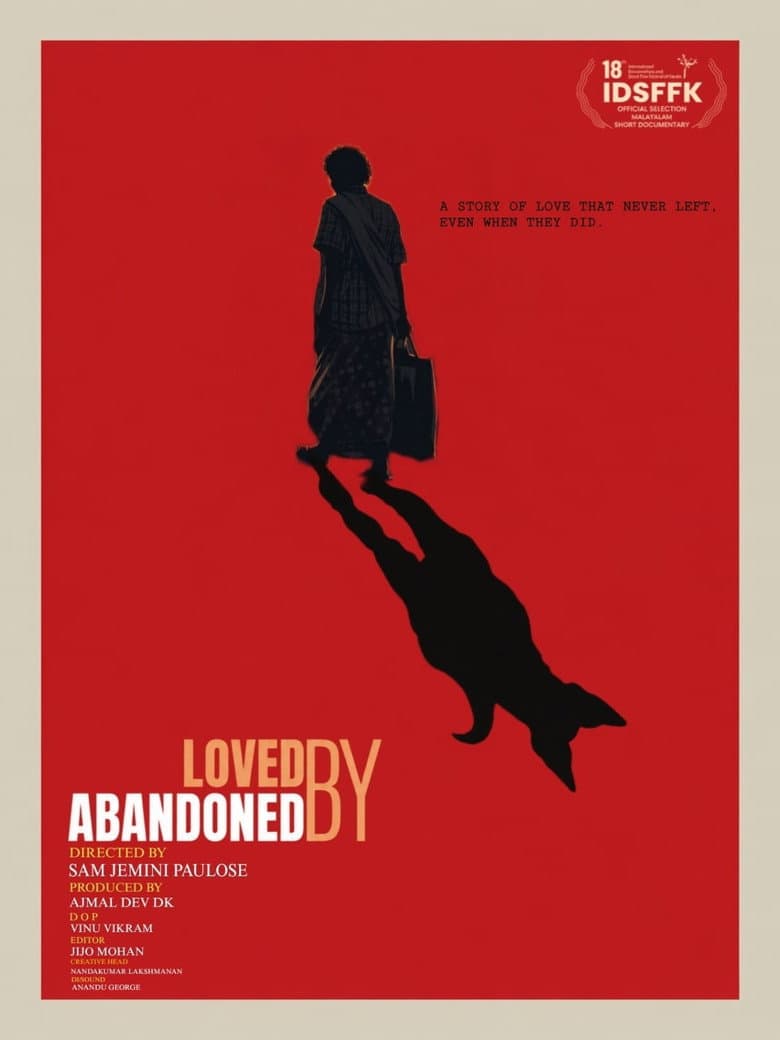
There is a quiet stretch of railway track in Velloor where the day begins not with a whistle but with the sound of a woman calling out to the morning. Elikutty, weathered by decades and draped in the kind of worn cotton that has seen too many monsoons, moves along the edges of the village with a sack slung across her back. She is not collecting alms. She is collecting scrap - discarded bottles, rusted metal, forgotten things - and every rupee it earns goes to the dogs that trail behind her like a living shadow.
This is the world captured in Loved By Abandoned By, a twenty-minute documentary directed by JEMINISAM PAULOSE that has been quietly making the rounds since its release on September 28, 2026. The film, shot in Malayalam, belongs to the Mollywood industry and carries the kind of unassuming title that could be mistaken for a poem. It is not a poem. It is a portrait, and like all honest portraits, it refuses to look away.
The film opens with Elikutty's hands. They are the hands of a woman who has spent thirty years sorting through other people's refuse, and they move with a precision that speaks of long practice. In the background, a pack of stray dogs circles her, tails low but eyes alert. They know her voice. They know her footsteps. What they do not know, as the documentary gradually reveals, is why their numbers are beginning to thin.
The central mystery of Loved By Abandoned By is not a whodunit. It is something far more unsettling. Over the course of the film, Elikutty's canine companions begin to vanish. One by one, quietly, without explanation. She searches for them. She calls out into the empty afternoons. And the camera, held steady by Paulose, watches her watch the silence. It is a devastating piece of observational filmmaking, and it earns its emotional weight not through narration but through the simple, unbearable accumulation of absence.
NANDAKUMAR LAKSHMANAN appears in the film as an interviewer, a presence that could have easily disrupted the documentary's stillness. But the conversations between him and Elikutty are tender rather than intrusive. She speaks of the dogs as one might speak of children who have grown and left. She speaks of her own isolation with a matter-of-factness that is more moving than any lament. At one point, she explains that she never married, that her family drifted away, and that the dogs are the only ones who have stayed. When they begin to disappear, the film asks, without ever saying it outright: what happens to a person whose last companions are taken from them?
What is remarkable about Loved By Abandoned By is how it refuses to sentimentalize its subject. Elikutty is not presented as a saint. She is shown as tired, sometimes frustrated, occasionally sharp with the very animals she feeds. But that is precisely the point. Her selflessness is not the polished kind. It is the kind that comes from a life of scarcity, where giving away what little you have is not a gesture but a habit. The film understands that dignity does not always look dignified. Sometimes it looks like a woman arguing with a stray over a piece of bread.
Visually, the documentary leans into the textures of Velloor - the wet light of early mornings, the dust of late afternoons, the cramped corners where scrap piles up and dogs curl into sleep. Paulose, who previously worked on short-form social documentaries, keeps the camera close to the ground, often at the level of the dogs themselves. The effect is disorienting at first, then strangely intimate. We are not observing Elikutty from a distance. We are walking beside her.
The film runs just twenty minutes, and it uses every one of them. There is no fat here, no extraneous interview, no swelling musical score to tell us how to feel. What remains is a portrait of a woman who has been loved by the abandoned, and abandoned by the world that should have loved her back. The title itself is a quiet accusation, and the film never lets it go.
Since its release, Loved By Abandoned By has been largely invisible on commercial platforms, which is unsurprising for a short documentary in Malayalam with no marketing machinery behind it. But it deserves a wider audience, not because it is uplifting - it is not - but because it is true. It is the kind of film that sits with you long after the credits roll, in the same way that Elikutty sits by the tracks, waiting for dogs that may never return.
In the end, the documentary does not solve the mystery of the disappearing companions. It does not need to. What it offers instead is something rarer: the company of a woman who keeps giving anyway.