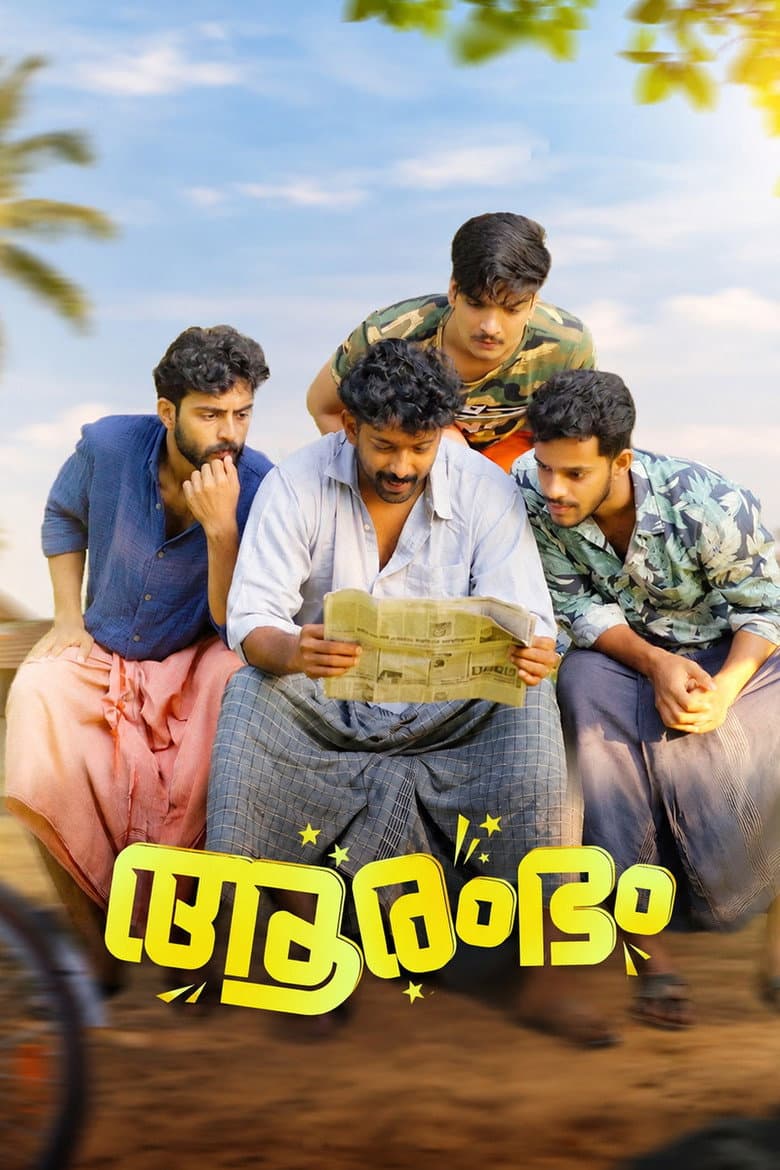
The four young men at the centre of Aarambham Oru Albaniyo Katha have a problem that will feel familiar to anyone who has ever sat across a dinner table while an uncle enumerates the failings of the current generation. They are graduates. They are unemployed. And in Bethoorpara, a village in North Kerala where everyone knows everyone and, more importantly, everyone knows everyone's business, that combination is treated less as a temporary setback than as a character flaw.
Sreejith M Nair's new film, which opened in theatres on 9 October 2026, takes this most ordinary of predicaments and, as its title suggests, asks what happens when the story refuses to begin the way anyone expects. The title translates roughly to "The Beginning is Also an Albanian Story" - a phrase that hangs over the narrative like a question mark, hinting at beginnings that arrive from elsewhere, uninvited, and rarely in the shape one has prayed for.
What the film does with its first act is establish, with what sounds like grim humour and a keen ear for small-town social dynamics, the daily grind of ridicule. Relatives who ask pointed questions at weddings. Neighbours who have already written the boys off. The slow erosion of self-respect that comes not from failure itself but from having to explain it, repeatedly, to people who have already decided the verdict. Nair, working from what appears to be an ensemble structure, follows the four friends through this landscape of casual humiliation, and the film's first achievement seems to be its refusal to sentimentalise them. These are not noble sufferers. They are simply stuck.
Then comes the job. And with the job comes trouble of a kind that nobody in Bethoorpara - including the four men who have spent years begging the universe for exactly this - could have anticipated. The marketing has kept the specifics of that trouble closely guarded, and it is a measure of the film's hold on audiences that the pivot has become one of the more discussed cinematic turns of the Malayalam October season. What can be said, in line with the official synopsis, is that the employment the friends have chased so desperately arrives carrying consequences far heavier than their salaries, and the second half of the 108-minute runtime follows their frantic, increasingly desperate attempts to escape a situation that has spiralled well beyond their control.
The genre description - drama, thriller - is unusually accurate here. The film appears to move from one register to the other with deliberate patience, spending its time building the texture of Bethoorpara's social world before tightening into something more urgent. Those two halves are not separate films; they are cause and effect. The same community that mocked the boys for having nothing may well prove to be the very thing that complicates their having something.
Nair is not among the industry's most visible directors, and the cast, in keeping with the filmmakers' preference for relative unknowns, has not been widely publicised. That choice of anonymity feels deliberate rather than incidental. A film about young men whom nobody takes seriously and whom the world has not yet bothered to name carries a certain extra charge when its performers are strangers to the audience - no previous screen persona to protect them, no star image to cushion the fall. Whether these faces become familiar names in the coming years is a question for another day; for now, they serve the story.
Aarambham Oru Albaniyo Katha arrives at a moment when Malayalam cinema is enjoying significant national attention, and its premise - small-town frustration tipping into something darker - sits comfortably within a tradition of storytelling from the region. But its specific alchemy, the way it weaponises a job offer, is its own. The film's rating on TMDb remains at zero out of ten simply because, at the time of writing, too few users have logged votes for the aggregate to mean anything. That number will settle in the weeks to come and should not be read as any kind of statement about the film itself.
What does seem clear is that the title's oblique promise is being kept. In North Kerala, in a village called Bethoorpara, four graduates wanted a beginning. They got one. It just was not the beginning they were expecting - and that, perhaps, is the most Albanian thing about it.