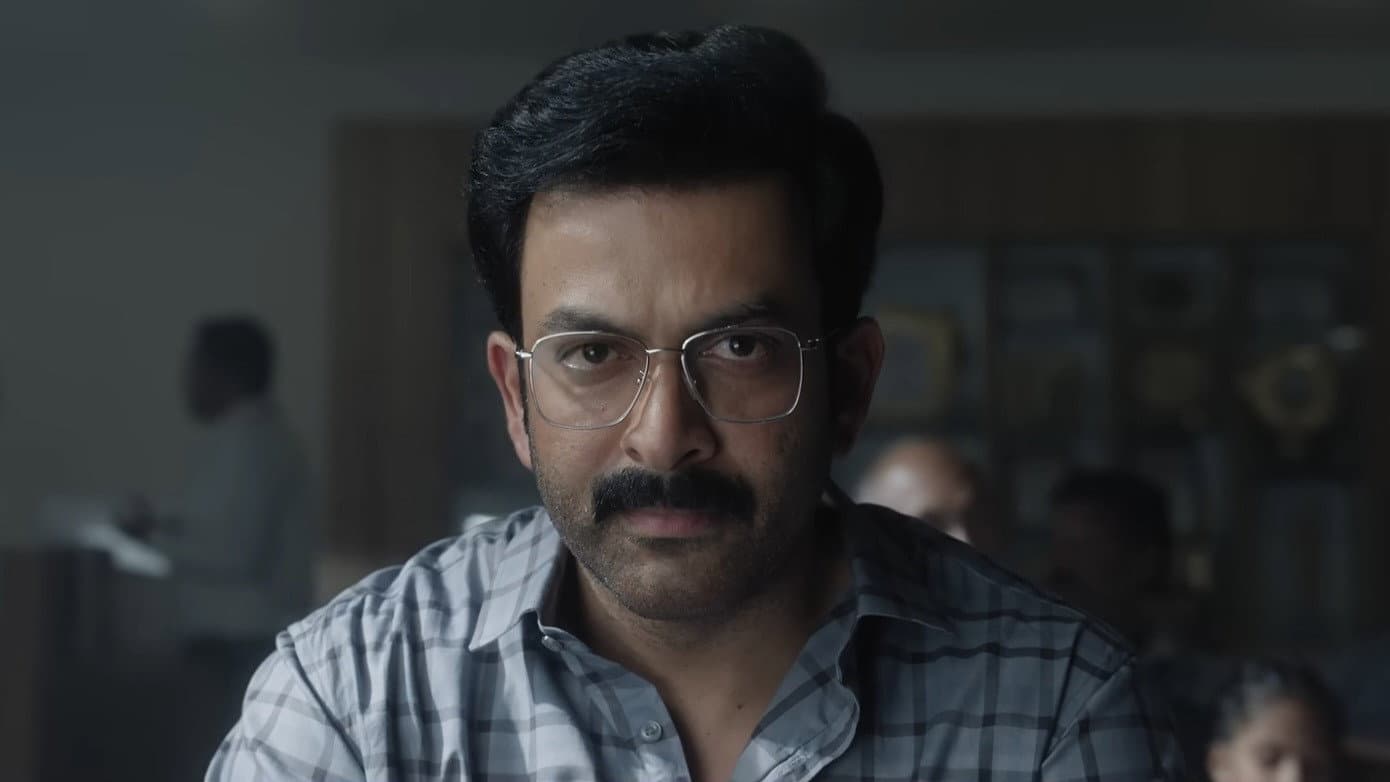
The quiet fury of a government clerk is not usually the stuff of cinematic legend. But then again, Rajeevan is not your usual clerk, and Nissam Basheer is not your usual director. With I, Nobody, the duo have crafted a 169-minute descent into paranoia that refuses to let the audience breathe, and the result is the most talked-about Malayalam film of this monsoon season. Released on July 9, the film has already cemented itself as a flawed, furious, and fiercely gripping thriller that dares to ask a terrifying question: what happens when the system decides you are the problem?
The premise is deceptively simple. Rajeevan (Prithviraj Sukumaran), an ordinary government employee, witnesses something he was never meant to see. That single moment of accidental sight detonates a chain reaction of violence, bureaucratic sabotage, and psychological warfare. He is branded a troublemaker, a nuisance, a man whose credibility must be destroyed before his testimony can take root. The film’s genius lies not in the spectacle of the chase, but in the grinding, mundane horror of it all. This is not a film about car chases and gunfights; it is about phone taps, fabricated files, and the slow, suffocating realisation that every institution designed to protect you has been weaponised against you.
Prithviraj delivers a performance that feels like a pressure cooker with a faulty valve. There is none of the swagger he brought to his recent action outings. Instead, he inhabits Rajeevan with a slump-shouldered weariness, a man whose world shrinks from an office desk to the four walls of his home. Watch his eyes during the film’s middle act, when he realises his own neighbours are being paid to watch him. The fear is not loud; it is a low hum of dread that vibrates through every frame. The actor understands that true terror is not a scream, but the silence that follows it.
As his wife Meera, Parvathy Thiruvothu is the film’s emotional bedrock. Her role could have easily been reduced to the “worried spouse” archetype, but Parvathy layers it with a pragmatic, steel-edged resilience. There is a scene, late in the film, where she confronts a senior officer without raising her voice, and the quiet authority she commands is chilling. She is not just a victim of the circumstances; she is a co-combatant, and the film is far stronger for it. The supporting cast, including the ever-reliable Ashokan as a compromised colleague and Vijayaraghavan as a Chief Minister who delivers platitudes like a guillotine, adds depth to the moral quicksand. Hakkim Shajahan, as the investigating officer Anas Rahman, deserves special mention; his performance is a masterclass in ambiguous menace, a man whose smile never quite reaches his eyes.
Director Nissam Basheer, known for his work in lighter, more comedic territory, makes a startlingly assured pivot here. He orchestrates the tension with a maturity that belies his filmography. The runtime is hefty, but it is earned. Basheer builds the world methodically, allowing the bureaucratic knots to tighten around Rajeevan with a deliberateness that mirrors real-life power structures. He knows that the most terrifying villains are not masked men in shadows, but middle-aged men in government offices stamping forms that destroy lives. The cinematography underscores this claustrophobia - long corridors, dimly lit verandas, and rain-streaked windows that reflect a world that is both familiar and hostile.
However, I, Nobody is not without its missteps. The middle section, while essential for character building, occasionally tests the viewer’s patience with repetitive cycles of accusation and denial. A subplot involving a colleague, Jomon, played by Madhupal, feels slightly undercooked, a thread that is introduced with great promise but is never fully tugged. Moreover, the TMDb rating of 6/10 suggests that general audiences may have found the pacing a touch too deliberate, favouring dread over immediate gratification. The film is uninterested in providing cathartic, explosive resolutions; it prefers the grim satisfaction of a drawn-out war of attrition.
Yet, that is precisely what makes I, Nobody essential viewing. It is a film that trusts its audience to understand that the greatest violence is often procedural. It is a commentary on the erasure of the individual, a thriller that finds its deepest horror in the casual cruelty of those in power. For Malayalam cinema, which has consistently pushed the envelope of realistic storytelling, this film is a bold statement. It is messy, it is long, and it is defiantly uncompromising. But in its final, haunting frame, as Rajeevan stands alone against a landscape that offers no sanctuary, you realise you have witnessed something rare: a mainstream star risking everything to play a man with nothing left to lose. For that alone, I, Nobody demands to be seen, argued about, and remembered.