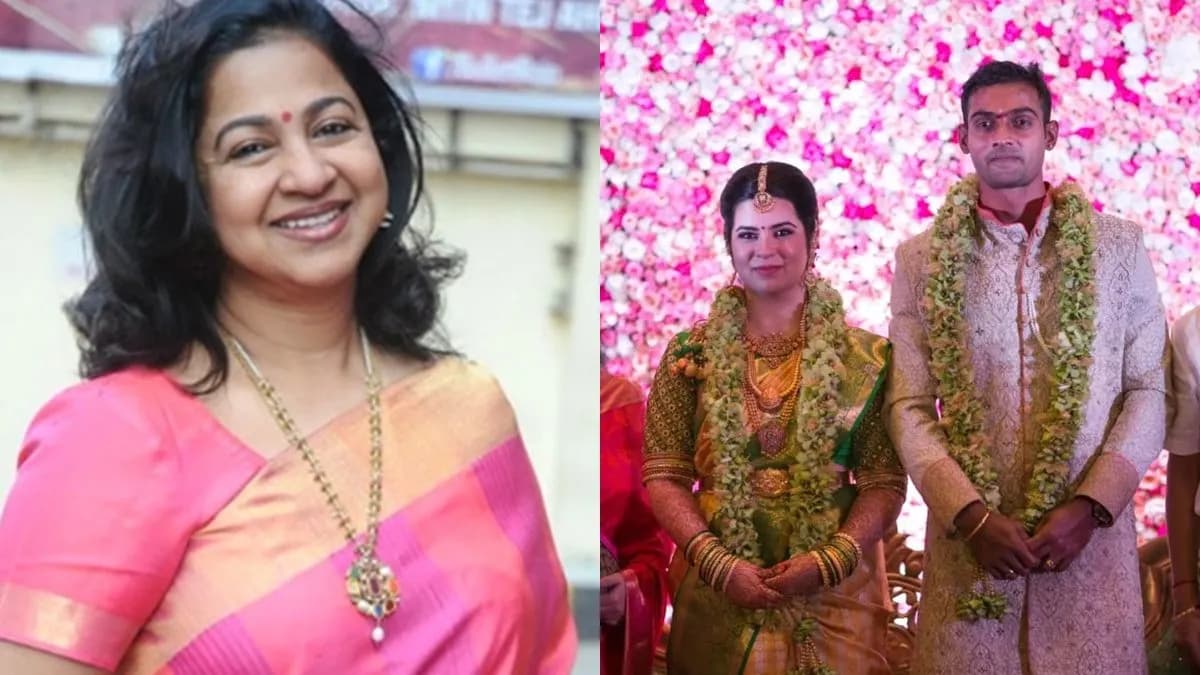
Radhika has revealed that she was the one who called off her wedding at the last moment, and that the person who advised her before the decision told her plainly that she should not come back complaining after the marriage. The actor's remarks, carried in a widely shared interview clip, offer a rare, unguarded look at a personal chapter she had largely kept to herself, and they have quickly become one of the most discussed celebrity statements of the week in Malayalam cinema circles.
According to her account, the wedding had been arranged and was moving forward when she began to feel that she could not go through with it. She described the change of heart as sudden rather than the result of a long period of doubt, and said she was the one who ultimately told those concerned that she no longer wanted the marriage to proceed. Radhika did not name the person who offered the advice, and she did not disclose when the episode took place, leaving the timeline of the called-off wedding unclear.
The advice that stayed with her
The line that has drawn the most attention is the counsel she says she received around the time of her decision. In substance, she was told that if she was going to walk away, she should do so without looking back, and that once married she should not return with grievances. Radhika recounted the words approvingly, suggesting she treated the bluntness as fair rather than unkind. The remark captures a familiar attitude in Malayalam families and social circles, where marriage is often viewed as a step that closes certain options, and where a woman who changes her mind is expected to absorb the consequences of that choice.
What makes her telling of it notable is the absence of defensiveness. She frames the advice as something she accepted at the time, not as an imposition she later resented. That tone has resonated with listeners, many of whom have read her comments as an argument for making such decisions early and honestly rather than drifting into a ceremony out of obligation.
A subject Malayalam cinema rarely airs so plainly
Public figures in the industry tend to speak about broken engagements only in carefully worded terms, if at all. Radhika's willingness to say outright that she was the one who backed out, and to repeat the caution she was given, puts her in a small group of women in Malayalam cinema who have addressed a cancelled wedding on their own terms. The disclosure also arrives at a moment when conversations about consent, family pressure and the timing of marriage have become more visible in the state's public discourse, and her remarks have been picked up well beyond film pages.
She has not suggested that the decision was easy, nor has she portrayed it as a rebellion. The impression she gives is of a choice made quickly, defended calmly and revisited without embarrassment. It is a framing that avoids casting anyone as a villain, including the person who warned her, and that may explain why the clip has travelled as far as it has.
Career continues without interruption
Radhika remains an active presence in Malayalam cinema, and nothing in her comments suggests the episode has affected her professional commitments. She has been part of films across a range of budgets and has built a following that extends past her screen work into the kind of personal candour on display here. The interview has added to that reputation rather than altered it. Audiences accustomed to seeing her in character now have a clearer sense of the person speaking in her own voice, and the response so far has been largely sympathetic.
It is worth noting what she did not say. She offered no details about the prospective match, no explanation for the timing of the announcement and no account of how families on either side reacted. Those gaps have not stopped speculation, but they also keep the story where she appears to want it, on the principle rather than the personalities involved.
Why the remark is being shared
The sentence at the centre of the discussion is less about marriage itself than about the conditions attached to a decision. Being told in advance that there would be no room for complaint afterward is, in one reading, a warning; in another, it is a form of respect, an acknowledgement that the choice belonged to her and that she would be held to it as an adult. Radhika seems to have taken it the second way, and that interpretation has given the quote its reach.
For an industry that often prefers its stars opaque, her frankness stands out. Whether she returns to the subject in future interviews remains to be seen, but for now the remark has done what few celebrity statements manage: it has started a conversation that has little to do with films and everything to do with how families talk to young women at the threshold of a wedding.
Source: Filmibeat Malayalam