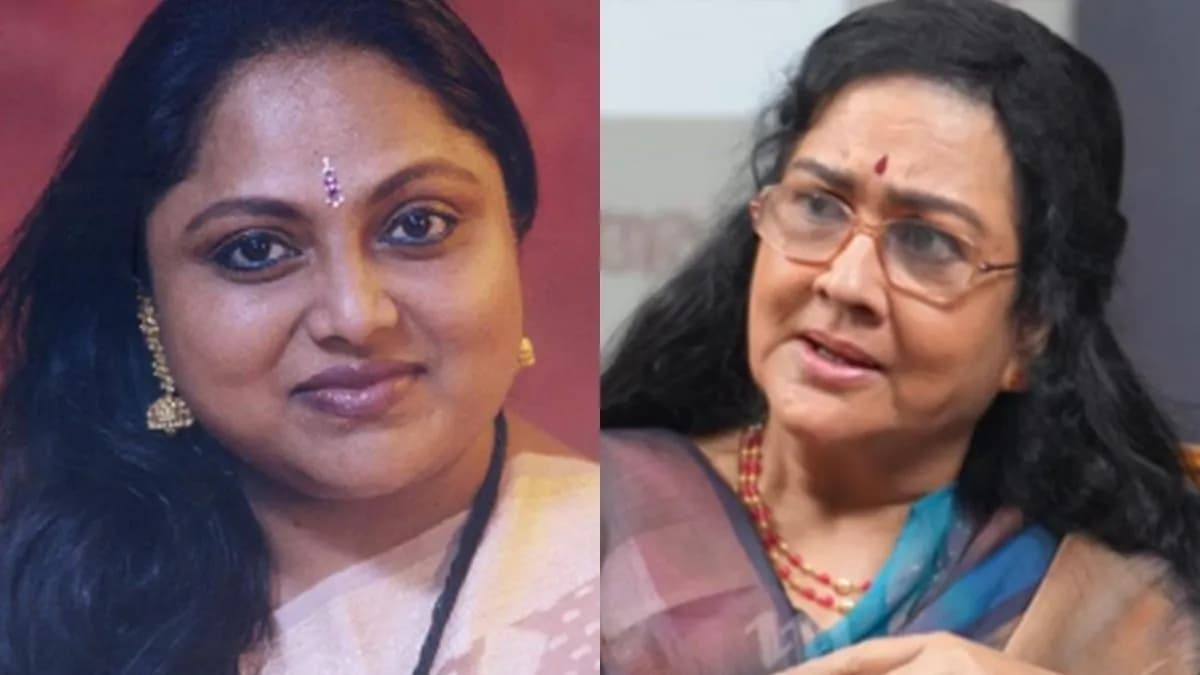
Veteran Malayalam actor Urvashi has long been regarded as one of the finest performers the industry has produced, and a fresh round of online discussion is asking a pointed question: why has she not received the kind of celebratory spotlight that has been extended to some of her contemporaries? The conversation, circulating widely among Malayalam cinema followers, frames Urvashi as an actor whose body of work deserves far more public recognition than it has received, while also touching on an older, much-repeated observation about jealousy among actresses directed at Saritha.
The discussion does not attach itself to any single film. It is instead a broader reflection on legacy, opportunity and the way Malayalam cinema chooses whom to honour, and when.
A Career Measured in Range, Not Volume
Urvashi made her presence felt in Malayalam cinema from a young age and never settled into one kind of role. She could carry a comic sequence with perfect timing, then turn around and deliver a performance of quiet devastation in a family drama. That versatility is precisely what makes the current debate sting for her admirers. Actors who can do everything are sometimes taken for granted, because they make difficult work look effortless.
Her filmography spans decades and multiple languages, and she has worked with directors across generations. She remains active, which adds another layer to the argument: this is not a case of an artist being rediscovered after years away. She is still here, still working, and still capable of anchoring a scene opposite performers half her age.
The Saritha Comparison That Refuses to Fade
Part of the renewed chatter centres on Saritha, another actor whose career ran parallel to Urvashi's in the 1980s and beyond. The claim being repeated online is that other actresses of that era were envious of Saritha, and that this envy shaped how opportunities were distributed. Whether that reading is fair or exaggerated is impossible to verify, and it should be treated as anecdote rather than record. Still, the fact that the observation keeps resurfacing says something about how persistently Malayalam cinema's fans revisit old hierarchies.
Both actors built careers on the same foundation: an ability to shift register without warning. Both were sidelined from leading roles at points when the industry's priorities changed. What is often described as rivalry between performers is frequently something else entirely, a structural preference for new faces over proven ones.
Why the Celebration Feels Delayed
Malayalam cinema has grown noticeably more generous with retrospectives, tribute events and lifetime achievement honours in recent years. Yet the timing of those gestures is rarely generous. Recognition tends to arrive after an artist has stopped being commercially central, or after a public campaign forces the issue. Urvashi's case fits that pattern uncomfortably well.
Her admirers argue that she should have been feted while still at her commercial peak, not retrospectively. The counterargument is that she has never been short of work or respect within the industry. Both things can be true at once. Critical regard and public celebration are not the same currency, and Malayalam cinema has historically been better at the first than the second.
There is also a subtler point in the debate. Actors who excel at humour are often denied the seriousness accorded to those who specialise in tragedy. Urvashi's comic gifts may have cost her the kind of solemn reverence that follows a career built on heavy drama. That is a criticism of audiences and awards bodies more than of her.
What This Conversation Is Really About
Strip away the nostalgia and the speculation, and the current discussion is about how Malayalam cinema remembers its women. Male performers of comparable longevity are routinely described as pillars of the industry. Their female counterparts are more often discussed in relation to who they worked with, or who they were supposedly in competition with. Framing Urvashi's career around jealousy towards another actor, rather than around her own achievements, repeats that habit.
The decision referenced in the chatter is vague and unattributed. No reliable account confirms who made it, when, or what it concerned. Readers should treat that portion of the story with caution. What can be stated plainly is that Urvashi's contribution is substantial, durable and still ongoing.
If the current wave of discussion achieves anything, it may simply be to push more viewers towards her older work. That is a worthy outcome on its own. A performer of her calibre does not need a viral post to justify her place in Malayalam cinema. She needs what she has always deserved: attention paid to the performances themselves, while she is still around to receive it.
Whether the industry will act on that sooner rather than later remains an open question. The conversation, at least, has started.
Source: Filmibeat Malayalam