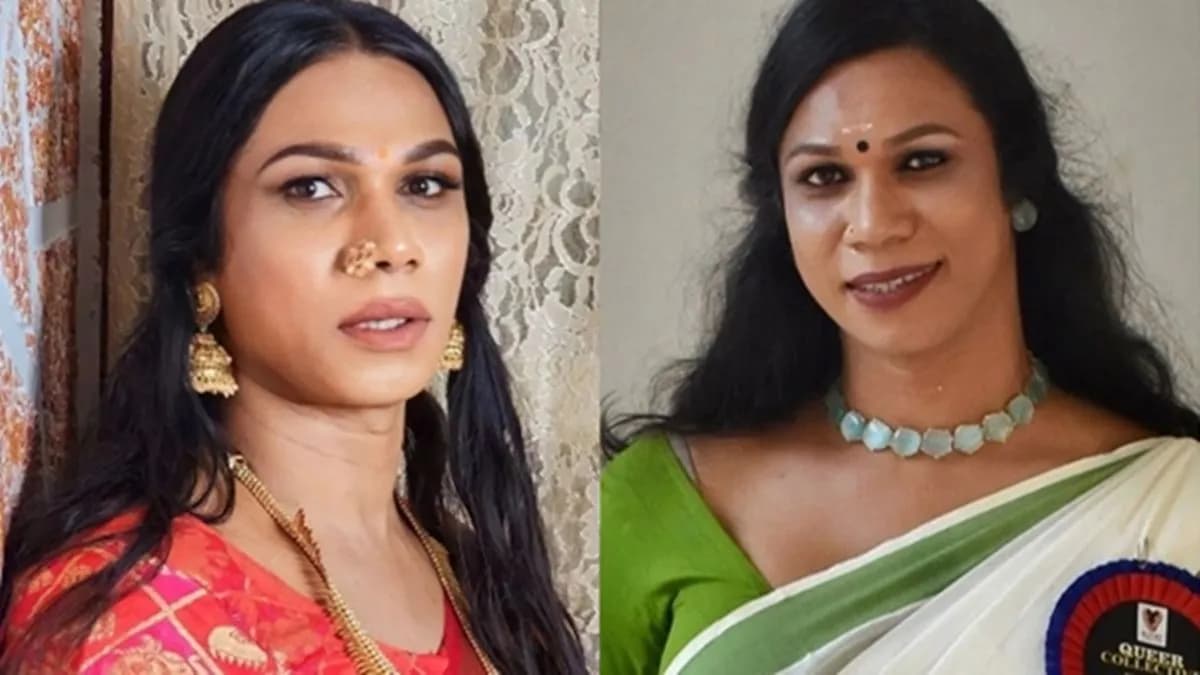
What began as a routine promotional conversation has turned into one of the more candid public disclosures to come out of Malayalam cinema this year. Actor Sheethal Shyam, speaking about her life during an interaction tied to her recent work, opened up about a childhood marked by an alcoholic and physically abusive father, and about an early certainty regarding her own identity that she says she never once doubted. Her remarks, which she framed as simply the story of her life rather than a formal announcement, have since circulated widely among Malayalam film audiences.
The emotional core of her account was her recollection of her father. She described a man whose drinking routinely turned violent, referring to him with the affectionate Malayalam word for father even as she recounted the beatings he inflicted. The translation of her sentiment is blunt: she told those listening that she had always been convinced he was not a man, using the word in the sense of decency and character rather than biology. It was the kind of line that lands heavily in a culture where the figure of the father is rarely questioned in public, least of all by a daughter speaking on the record.
A Childhood Framed by Fear at Home
Sheethal did not present her father as a monster in a story, but as a presence that shaped the texture of daily life. Violence at home, she suggested, does not announce itself as tragedy. It becomes routine - the sound of a vehicle in the driveway, the shift in a voice, the decision about which room to be in. That atmosphere, according to her telling, was the backdrop against which she grew up, and it formed her understanding of what she was unwilling to accept in her own life.
What stands out in her account is the absence of self-pity. She spoke as someone who has processed the past rather than someone still living inside it. There was no appeal for sympathy, no call for anyone to be punished. The narrative was hers to control, and she exercised that control by naming what happened plainly and then moving on, treating the disclosure as context for who she is rather than as a revelation designed for effect.
Certainty About Identity, Stated Without Apology
Alongside the family history, Sheethal spoke about her own sense of self, saying she had known - with complete certainty - that she was not a man. In her telling, this was not a discovery made after struggle, nor a conclusion reached through years of confusion. It was knowledge she possessed early, held onto quietly, and never seriously entertained contradicting. She framed it as a fact about herself that required no external validation, only the eventual courage to live in accordance with it.
The pairing of these two threads - a violent household and an unshakeable self-knowledge - gives her story its shape. One involved a figure who abused the authority of his role; the other involved her own refusal to accept a role assigned to her. The contrast is not something she spelled out in so many words, but it runs through everything she said.
Why the Comments Are Resonating
For an industry that has grown more willing to host frank conversations about gender, family and identity, Sheethal's remarks arrive at a receptive moment. Malayalam cinema has produced a run of films and public discussions that push against inherited expectations, and actors who speak personally tend to draw attention precisely because the personal and the professional are so tightly braided here. Audiences know her from the screen; hearing her describe the life behind it changes how they watch her.
That is the subtle power of a disclosure like this. It does not rewrite a filmography. It adds a layer of meaning to it. Viewers who encounter her on screen after hearing these remarks will read her performances differently, not because the work has changed, but because the person doing the work has become more fully visible.
Sheethal, for her part, appears uninterested in turning any of this into a campaign. She offered her life as an answer to a question, not as a manifesto. The statements were direct, occasionally painful, and delivered without hedging. In an era when celebrity candour is often engineered, hers had the texture of something said because it was true, not because it was useful.
Whether the conversation around her remarks continues to build or fades into the usual news cycle remains to be seen. Either way, she has already done the harder thing: she told it straight, on her own terms, with no one else's framing attached.
Source: Filmibeat Malayalam