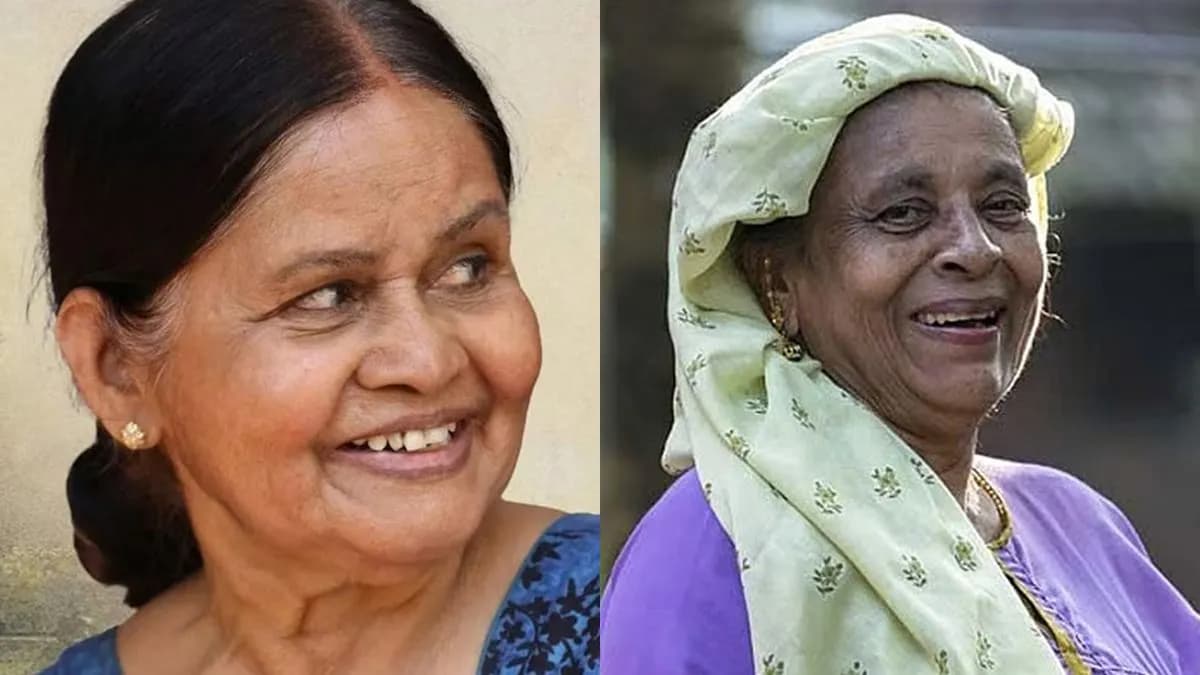
Veteran Malayalam actor Savithri Sreedharan has said she would gladly join a project if her close collaborator Saraswathi is part of it, while admitting she still carries a lingering regret over the recognition that has eluded her fellow artist. The remark was made in a recent interaction and has been circulating widely among Malayalam cinema followers, touching a familiar nerve about how the industry treats some of its most dependable supporting talents.
Sreedharan, who found nationwide attention later in her career, framed the thought simply. If Saraswathi is there, she said, she too would come. And then the more candid part: it bothers her that something Saraswathi deserved has not come her way.
A Bond Shaped on Set
The two actors have shared screen space in a handful of Malayalam films and are frequently spoken of together by those who follow character acting in the industry. Sreedharan's comment was not a formal announcement of any new project; it was an expression of personal loyalty, the kind that surfaces when one performer watches another deliver consistently without proportionate reward.
What gives the statement its weight is the career the speaker herself has had. Sreedharan came to wider public notice relatively late, after decades of work in theatre and in small film roles. When recognition finally arrived, it arrived loudly, and she has since become one of the more sought-after older women in Malayalam cinema, cast in parts that demand both warmth and steel.
That trajectory is precisely why her words carry. She knows what it is to wait.
The Uneven Arithmetic of Character Roles
Malayalam cinema has, over the past decade, developed an unusual appetite for mature performers. Films built around older protagonists have travelled well, and actors who might once have been limited to a scene or two now anchor entire narratives. The shift has been real, and it has been widely celebrated.
It has also been uneven. A handful of names benefit from the renewed interest; a longer list does not. For every actor who suddenly finds themselves fielding offers, there are several more with comparable range who continue to be called only for functional roles, or not called at all.
Sreedharan's remark about Saraswathi sits squarely in that gap. She is not speaking about opportunity in the abstract. She is speaking about a specific person whose work she rates and whose lack of a certain kind of success she finds hard to accept.
What the Comment Signals
On its face this is a small thing, a line offered in conversation. In context, it reads as a quiet critique. When an actor of standing volunteers that she will show up only if a particular colleague is also invited, she is signalling that casting decisions are not always made on merit alone. She is also, in her way, applying gentle pressure. It is easier for a producer to say no to one actor than to a pair.
There is nothing new about senior performers advocating for one another. Ensemble relationships are the connective tissue of any film industry, and Malayalam cinema's relatively small scale makes those bonds tighter than most. What is less common is for the advocacy to be stated so plainly in public.
Sreedharan did not name a film, a director or a timeline. She did not present the remark as a demand. That restraint is part of why it landed.
The Two Careers Side by Side
Sreedharan's own late-career prominence is now well documented; she has become a familiar presence at awards functions and in promotional material for films that lean on her name. Saraswathi's path has been quieter, built on steady work rather than a single breakout.
Placed side by side, the two careers are a compact illustration of how fortune distributes itself in cinema. Comparable training, comparable craft, very different visibility. Sreedharan appears to be saying as much without saying it explicitly, and her willingness to attach her own participation to her colleague's inclusion is the practical form that sentiment takes.
Whether the comment prompts anything concrete remains to be seen. South Indian cinema's casting cycles move fast, and public remarks by actors rarely translate directly into decisions. But they do shape conversations, and this one has already started a few.
For now, the line stands as an unusually direct piece of solidarity from an actor who has earned the right to be heard, aimed at someone she believes has not yet been heard enough.
Source: Filmibeat Malayalam