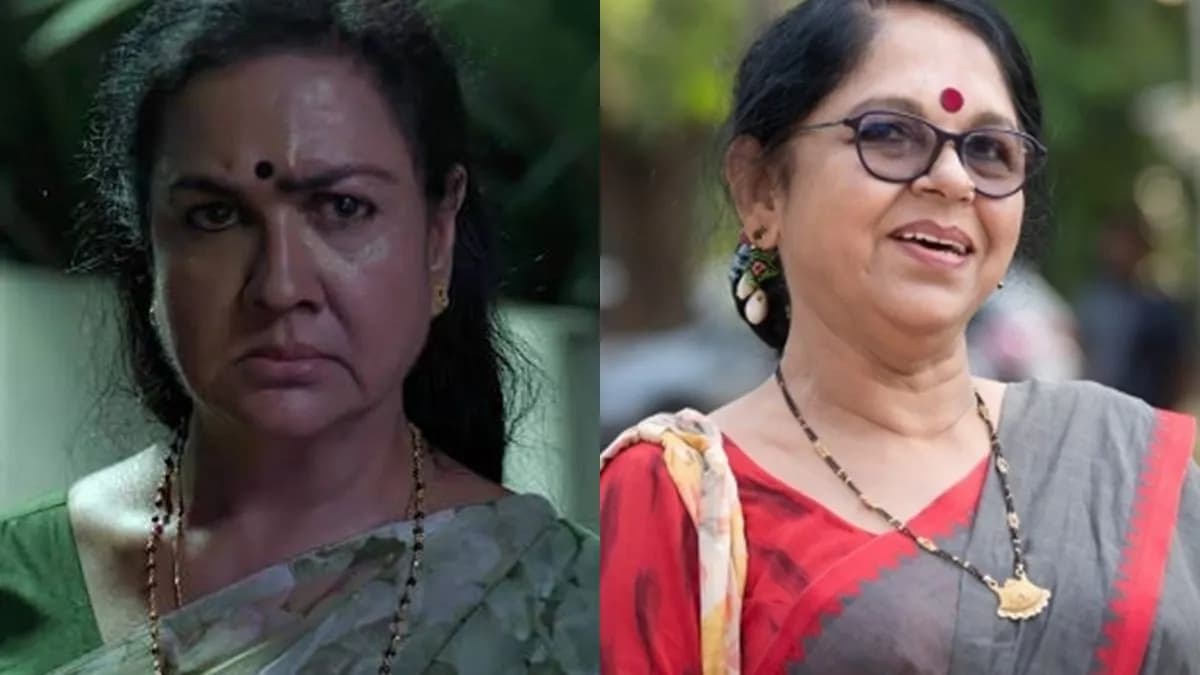
Writer S. Sharadakkutty has weighed in on a debate that has quietly been building among Malayalam cinema audiences, arguing that the role of Urvashi in the forthcoming film is one that no other performer could carry. Her remarks arrive as the industry continues to discuss the project's decision to centre the narrative on a single character, a choice that has prompted both admiration and scepticism.
In a note shared publicly, Sharadakkutty addressed the question of casting directly. She said that Urvashi alone can do justice to this character, and that any suggestion of an alternative was, in her view, beside the point. The statement carries particular weight given Sharadakkutty's long association with Malayalam letters and her familiarity with the kind of female characters that have defined the industry's more thoughtful work.
The wider conversation, however, is not only about who performs the part. It is about how the film is built. A solo walk - a narrative carried almost entirely by one performer - is an unusual proposition in a market that still leans heavily on ensemble casts, star pairings and the familiar rhythms of comedy, romance and family drama. Sharadakkutty's note questions that solo structure, asking whether a story told through a single presence can sustain the weight placed upon it.
Her intervention has been read in some quarters as a defence of the performer and in others as a critique of the approach. Both readings are probably fair. Sharadakkutty does not dispute Urvashi's standing; she treats it as settled. What she challenges is the assumption that a film organised around one figure is automatically the right vehicle for that figure's talent.
A debate about form, not just fame
Malayalam cinema has produced memorable single-character studies before, often in its independent and low-budget corners, where limited resources compel a stripped-back approach. What distinguishes the current discussion is that it is unfolding around a mainstream project involving a performer of considerable renown. When a star of Urvashi's generation takes on a role designed to stand alone, expectations shift and so do the risks.
The doubt Sharadakkutty raises is structural. A solo walk places enormous demand on writing, pacing and directorial control. If the script does not hold, the performer is exposed. If the staging is static, the audience's attention drifts. These are craft problems, not questions of ability, and they are the ones her note appears to foreground.
There is also the matter of what such a film asks of its audience. Malayalam viewers have shown themselves willing to embrace intimate, character-driven work in recent years, but they have also been quick to reject experiments that feel like exercises rather than stories. The line between the two is thin, and it is usually the writing that decides which side a film lands on.
The industry's habit of second-guessing
Sharadakkutty's comments also touch a familiar tendency in the Malayalam film world: the readiness to speculate about casting before a film has even been seen. Fan circles and social media threads routinely propose alternatives, rewrite scripts in hindsight and treat every announcement as an invitation to debate. Much of this is harmless enthusiasm. Some of it is not.
Her note pushes back at that reflex. If the character was written for Urvashi, she suggests, then the question of who else might play it is not merely hypothetical; it misreads the work. A role shaped around a particular performer's instincts, timing and emotional register is not a slot that can be filled at will. Casting in that sense is not interchangeable, and treating it as such diminishes both the actor and the writing.
At the same time, the solo format invites scrutiny precisely because it concentrates risk. A film with one central presence has fewer places to hide. If the performance falters, there is no subplot to absorb the slack. Sharadakkutty's note acknowledges that pressure without predicting failure, which is a more measured position than much of the online commentary surrounding the project.
For audiences, the practical question remains unchanged. The film will be judged when it arrives, not before. What Sharadakkutty has done is frame the terms of that judgment: not whether another actor could have been cast, but whether the film's chosen form serves the story it wants to tell. On that score, the answer will come from the screen, and from an audience that has always been willing to argue about it afterwards.
Source: Filmibeat Malayalam