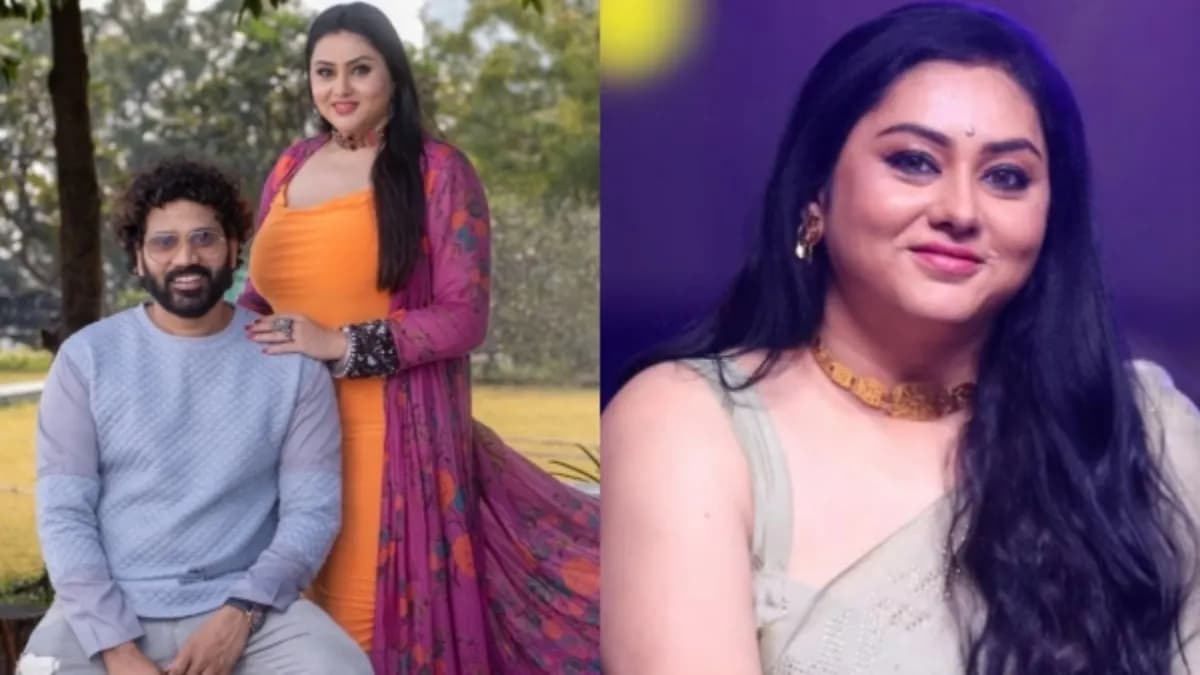
Actor Namitha has weighed in on one of the most persistent debates in Malayalam cinema's off-screen discourse, questioning why customs such as the wedding pendant, vermilion, and ritual fasting are framed as obligations for women alone. Her remarks, which arrived as a pointed rhetorical question rather than a prepared statement, take direct aim at the gendered logic that governs so much of organised religious practice in Kerala.
Namitha's intervention lands in a conversation that Malayalam cinema itself has kept alive for decades. The industry has produced celebrated films that interrogate ritual, custom, and the unequal burden placed on women during weddings and festivals, and its stars are frequently drawn into the same arguments once they step outside the frame. What distinguishes her contribution is its refusal to treat the question as a provocation. She is not asking whether tradition deserves respect. She is asking why its weight is distributed so unevenly.
A Question Aimed at Scripture, Not Just Society
The sharpest edge of Namitha's argument rests on religious texts themselves. If the pendant, the vermilion mark, and the vow are not explicitly mandated for women in the scriptures, she asks, on what authority do they become mandatory in practice? The question is not new. Scholars and reformist thinkers across communities have raised it repeatedly, pointing to the gap between what is written and what is enforced. What changes when a public figure puts it in plain language is the audience it reaches.
For many households, the wedding pendant is not merely an ornament. It is a marker of marital status, and around it cluster expectations about behaviour, appearance, and obedience. Vermilion carries similar symbolic freight. Fasting, meanwhile, is often treated as a woman's spiritual duty, undertaken for the wellbeing of husbands and children rather than for the woman's own religious life. Namitha's question pushes at that asymmetry by asking why the same demands are not applied with equal insistence to men.
That framing matters because it shifts the discussion away from individual devotion. A woman who chooses to wear a pendant or observe a fast is not the target of the argument. The target is the expectation that she must, and the assumption that a man need not.
Familiar Territory for Malayalam Cinema
Malayalam cinema has never been shy about this terrain. Filmmakers have used ritual as a lens to examine caste, patriarchy, and social control, and female stars have increasingly used their public platforms to echo those critiques. Social media has accelerated the shift, turning a single remark into a debate that unfolds across news outlets, comment threads, and family group chats within hours.
Namitha's timing places her within that stream rather than apart from it. Malayalam cinema's audience has grown more willing to engage with such questions, and its stars more willing to ask them. The result is a public conversation that moves faster than institutions can respond to, and that often outpaces the films themselves.
The reaction has predictably split along familiar lines. Some have read her words as an attack on tradition. Others have welcomed them as an overdue articulation of something many women have felt but rarely voiced so directly. Both responses confirm the premise of her question: the subject remains charged precisely because it touches daily life rather than abstract doctrine.
Her phrasing also resists the easy counterargument. She does not claim that tradition is meaningless, nor does she demand that anyone abandon personal faith. She points to a missing textual basis and asks what fills the gap once that absence is acknowledged. It is a question about authority as much as about custom, and it is harder to dismiss than a straightforward call for change.
What the Debate Signals
For the industry, the episode is a reminder that its stars operate in a cultural space far wider than the box office. Malayalam cinema's leading women have become participants in the social arguments their films often dramatise, and audiences increasingly expect them to speak. Whether that expectation is fair is its own question, but it is now a fact of the landscape.
Namitha's remarks are unlikely to settle anything. Debates of this kind are not resolved by a single statement, and the practices she names will continue to be observed, defended, and contested in households across the state. What her intervention does is keep the question visible: if the scriptures do not prescribe these obligations for women alone, why does practice insist otherwise? It is a query that predates her by generations, and one that Malayalam cinema, on screen and off, appears in no hurry to retire.
Source: Filmibeat Malayalam