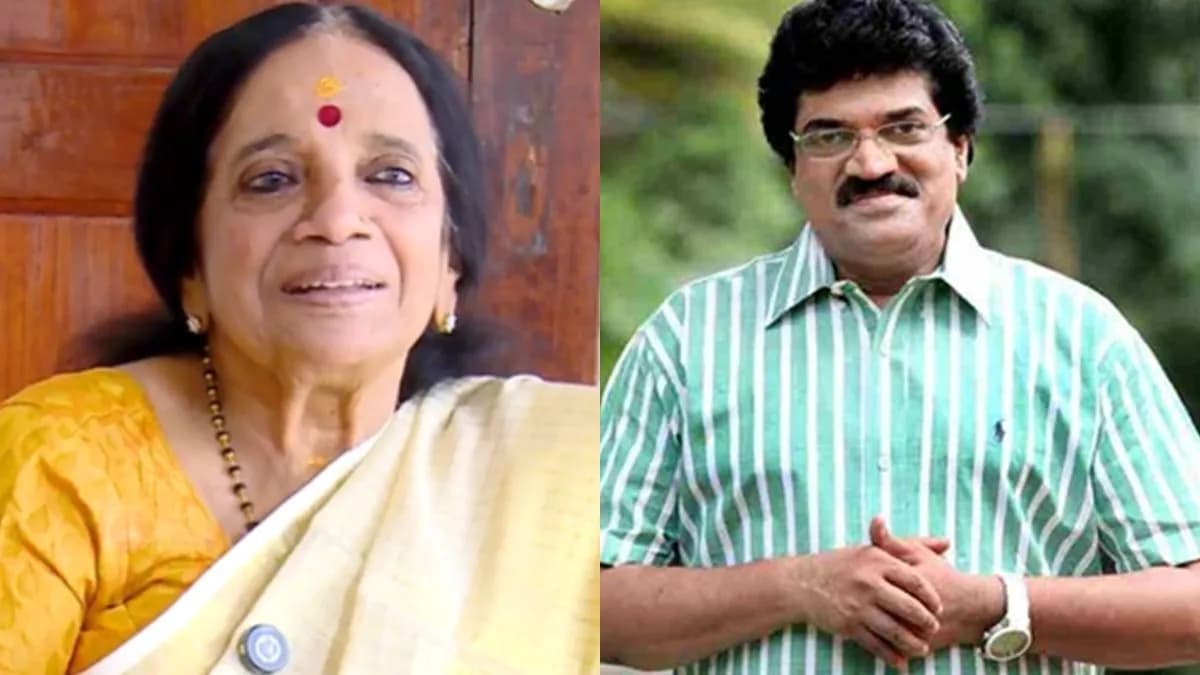
Veteran Malayalam playback singer and music director K. Omanakkutty has weighed in on a simmering controversy surrounding the legendary M.G. Sreekumar, offering a candid clarification that is likely to surprise many fans of the iconic voice. In a recent interaction, Omanakkutty addressed two swirling questions that have long hovered over Sreekumar’s career: whether the younger sibling ever formally trained in music, and whether a reported rift ever truly existed between Sreekumar and his elder brother, the renowned composer M.G. Radhakrishnan.
According to Omanakkutty, the popular belief that Sreekumar underwent rigorous, systematic classical training before his playback debut is essentially a myth. The veteran artiste stated plainly that, in reality, the younger singer never "learned" music in the conventional sense of attending formal lessons or undergoing disciplined tutelage under a guru. Instead, Omanakkutty suggested, Sreekumar’s extraordinary command over melody, rhythm, and emotive rendering was an innate gift, honed not in a classroom but through relentless immersion, exposure, and an almost instinctive absorption of the musical environment around him. This revelation adds a new dimension to the public’s understanding of a performer whose vocal range and versatility have dominated Malayalam cinema for decades.
Omanakkutty’s remarks implicitly touch upon the unique dynamic within the famous M.G. family, a household that produced two towering figures in Malayalam film music. While Radhakrishnan was celebrated as a meticulous composer with deep roots in classical ragas, Sreekumar emerged as a powerhouse singer whose voice became synonymous with the golden age of Malayalam cinema in the 1980s and 1990s. The question of whether the brothers shared a strained personal or professional relationship has been a recurring topic of gossip in industry circles for years. Omanakkutty’s latest statement seems to push back against any narrative of a major falling-out, though his phrasing suggests that the relationship was nuanced rather than perfectly smooth. He appears to indicate that whatever friction may have existed was blown out of proportion, or that the two simply had different creative temperaments shaped by distinct paths to their craft.
The distinction between formal education and natural talent is a significant one, especially in the context of Indian film music, where classical pedigree is often treated as a gold standard. By asserting that Sreekumar did not "learn" music, Omanakkutty is not diminishing the singer’s capabilities. On the contrary, he seems to elevate them, framing Sreekumar’s gift as something closer to divine providence or innate brilliance - a raw, unmanufactured ability that transcended the need for academic validation. This perspective aligns with the widespread admiration for Sreekumar’s astonishing breath control and his ability to effortlessly switch between playful folk numbers, soulful laments, and high-pitched romantic duets without any visible strain.
The timing of these comments is notable, as Malayalam cinema continues to revisit its musical heritage through re-releases, retrospectives, and biographical features. For a younger generation that primarily knows M.G. Sreekumar through his immortal hits from films like His Highness Abdullah, Kilukkam, and Mimics Parade, Omanakkutty’s clarification offers a fresh lens. It humanizes a figure who has often been perceived as an untouchable institution, reminding audiences that his journey was not one of conventional preparation but of exceptional, perhaps even accidental, destiny.
Meanwhile, the subject of the alleged conflict with his elder brother remains a sensitive topic. Omanakkutty’s comments suggest that, while there may have been natural professional friction between two strong-willed artists working in close proximity, it never escalated into the kind of bitter estrangement that gossip columns often hinted at. The veteran’s voice adds a layer of authority to the conversation, as he was a contemporary who worked within the same musical ecosystem and would have had direct insight into the private realities of these public figures. His refusal to confirm a dramatic feud, while simultaneously acknowledging subtle differences, paints a portrait of a relationship that was loving but perhaps not without its quiet tensions.
For fans, the revelation about Sreekumar’s lack of formal training is a double-edged sword. On one hand, it demystifies the singer, stripping away the myth of a disciplined student perfecting his craft for years. On the other hand, it amplifies the wonder of his achievement. If he never practiced scales in the traditional way, how did he achieve such effortless precision? Omanakkutty’s answer seems to be that some voices are simply born, not made. The comments also serve as an indirect tribute to Radhakrishnan, whose compositions provided the canvas for his brother’s extraordinary instrument. Whatever the nature of their personal equation, their artistic collaboration left an indelible mark on the soundtrack of Malayali life.
As the industry continues to celebrate its luminaries, Omanakkutty’s statements invite a broader conversation about how we measure musical greatness. Is formal training essential, or does raw emotion and instinct matter more? In Sreekumar’s case, the sheer volume of beloved recordings speaks for itself. The new clarification does little to alter his legacy but adds a fascinating footnote to his biography. For longtime listeners who have spent decades humming his tunes, it is a reminder that magic rarely follows a rulebook. And for those who have always wondered about the brothers behind the music, it offers a glimpse, however partial, into a complex kinship that was defined more by shared passion than by public discord.
Source: Filmibeat Malayalam