Advertisement
160×600
Left Ad

Kurup Movie Review: A Stylish & Dark Crime Saga
Director
Srinath Rajendran
Language
ML
Release
2021-11-12
Runtime
155 min
Quick Verdict
Kurup is a slickly produced true-crime thriller that never quite earns the weight of its grim real-life inspiration. Dulquer Salmaan delivers a magnetic performance as the elusive fugitive, but the film’s sprawling runtime and diffused focus prevent it from becoming the taut, gripping manhunt it could have been. It’s a confident, visually polished entertainment that leaves you more impressed by its lead’s charisma than shaken by the monstrousness of its central crime. A solid, if slightly padded, crime drama.
Story
The film takes us back to the early 1980s in Kerala. Sukumara Kurup (Dulquer Salmaan) is a restless, ambitious man who feels trapped by his middle-class life. He concocts a chillingly calculated plan: fake his own death and frame an innocent man for it, so his family can claim a hefty insurance payout. The target is a local bank clerk, Charlie (Tovino Thomas), whose burned, unidentifiable corpse is recovered from a wrecked car. As the police-led by the tenacious DYSP Krishnadas (Indrajith Sukumaran)-begin to piece together the evidence, the narrative shifts between Kurup’s meticulous escape and the dogged investigation that follows. The story is told in a non-linear fashion, jumping between Kurup’s pre-crime scheming, the immediate aftermath, and the long, frustrating years of his disappearance. It covers Kurup’s life on the run, his relationships with women (Sobhita Dhulipala plays his wife), and the toll the case takes on the officers who refuse to let it go.
Review
Director Srinath Rajendran clearly set out to make a stylish, psychological crime saga, and in many technical respects, he succeeds. The cinematography by Nimish Ravi is lush and evocative-sun-soaked Kerala backwaters give way to grimy, neon-lit Bombay streets, and the jump in eras is handled with period-appropriate costumes and vehicles that feel authentic. The score, by Sushin Shyam, is a character in itself: thrumming bass and dissonant synth pulses keep the tension humming even when the script loses momentum.
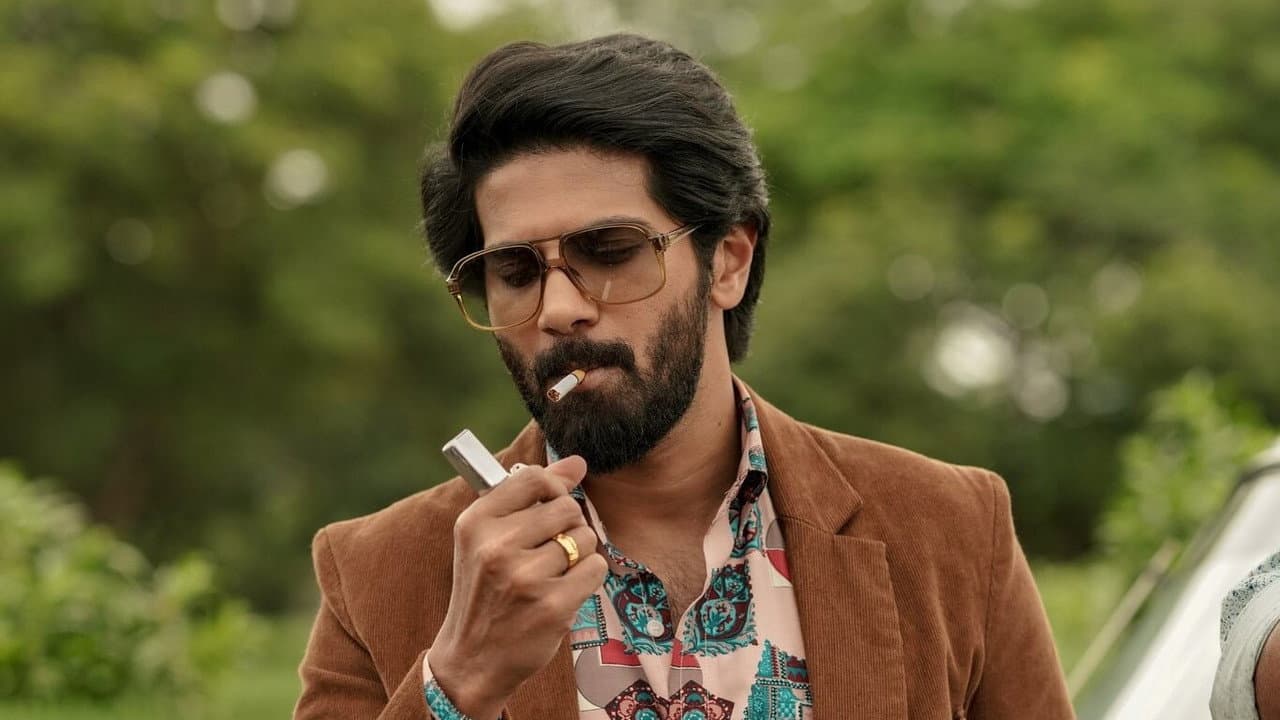
Dulquer Salmaan is the film’s undisputed anchor. He plays Kurup not as a cackling villain but as a cold, detached pragmatist. There’s a reptilian stillness to him-his eyes rarely betray emotion, his voice is eerily calm when he explains his monstrous plan. It’s a performance that suggests a man who has already detached himself from normal human morality, making the character unsettling rather than merely charismatic. The sequences where he meticulously plans the murder, or casually disappears into a crowd, are the film’s strongest.
Where Kurup stumbles is in its structure and pacing. The investigation side of the story, centered on Indrajith’s DP Krishnadas, is surprisingly thin. The character is given a framed photograph and a lot of weary sighs, but little psychological depth. The supporting cast-including Shine Tom Chacko and Sunny Wayne as associates-are underutilized, popping in for expository scenes and vanishing. The narrative’s decision to cover decades of Kurup’s life on the run dilutes the core tension. By the second hour, the film becomes a series of vignettes: Kurup evades capture, changes identities, finds a new lover, moves to another city. The procedural cat-and-mouse game we expect from a crime thriller gets replaced by a meandering biography.
The film also struggles with tone. It wants to be a serious, even dark, exploration of a real-life sociopath, but it sometimes indulges in stylistic flourishes (slow-motion walks, moody montages) that feel more suited to a glamorous gangster biopic. The script, by Daniel Menon and Prashant Kurup, sidesteps the actual brutality of the murder-Charlie’s death is rendered with quick, almost sanitized editing-which is a missed opportunity to ground the film’s glamour in visceral reality. The result is a movie that feels luxurious but not dangerous.
The ending, which shows Kurup’s ultimate fate (spoiler: he remains uncaptured, as history dictates), lands with a muted thud. It’s historically accurate but dramatically unsatisfying. The final scenes try to suggest that Kurup’s freedom is a kind of hollow victory, but the film hasn’t invested enough in his internal anguish to make that stick.
Pros & Cons
Pros
- Dulquer Salmaan’s performance is hypnotic-cold, smart, and fully committed.
- Gorgeous cinematography that captures 1980s Kerala and Bombay with tactile precision.
- Sushin Shyam’s score (especially the theme) elevates the tension in key sequences.
- The first-act setup of the crime is tight, economical, and genuinely gripping.
- Period details (cars, clothes, phones) are meticulously rendered.
Cons
- The investigation half is underwritten; Indrajith’s policeman is more symbol than character.
- Pacing drags in the second half as the story becomes a repetitive escape reel.
- The female characters (Sobhita Dhulipala, others) are given minimal agency or depth.
- The film sanitizes the brutality of the real crime, weakening its emotional impact.
- The non-linear structure sometimes undercuts suspense by showing outcomes before setups.
Rating Breakdown
Final Verdict
Kurup is a handsome, well-acted crime drama that ultimately prioritizes style over substance. Dulquer Salmaan delivers a career-best turn as the devil in plain sight, but the film’s refusal to confront the ugliness of the real-life Charlie Murder Case, coupled with a bloated second half, keeps it from reaching the heights of the best Malayalam crime thrillers. It’s worth watching for the performance and the technical craft, but don’t expect the haunting, edge-of-your-seat experience the premise promises. A good film, not a great one.
Rating: 6.5/10
Cast

Dulquer Salmaan
Sukumara Kuruppu

Sobhita Dhulipala
Sharada

Indrajith Sukumaran
DYSP Krishnadas

Tovino Thomas
Charlie

Shine Tom Chacko
Bhasi Pillai

Sunny Wayne
Peter

P Balachandran
Gopalakrishna Pillai

M R Gopakumar
Charlie's father

Sudheesh

Surabhi Lakshmi

Vijayaraghavan
Kurup’s father

Bharath Srinivasan
Izaakh
Gallery







Related Reviews


Advertisement
160×600
Right Ad