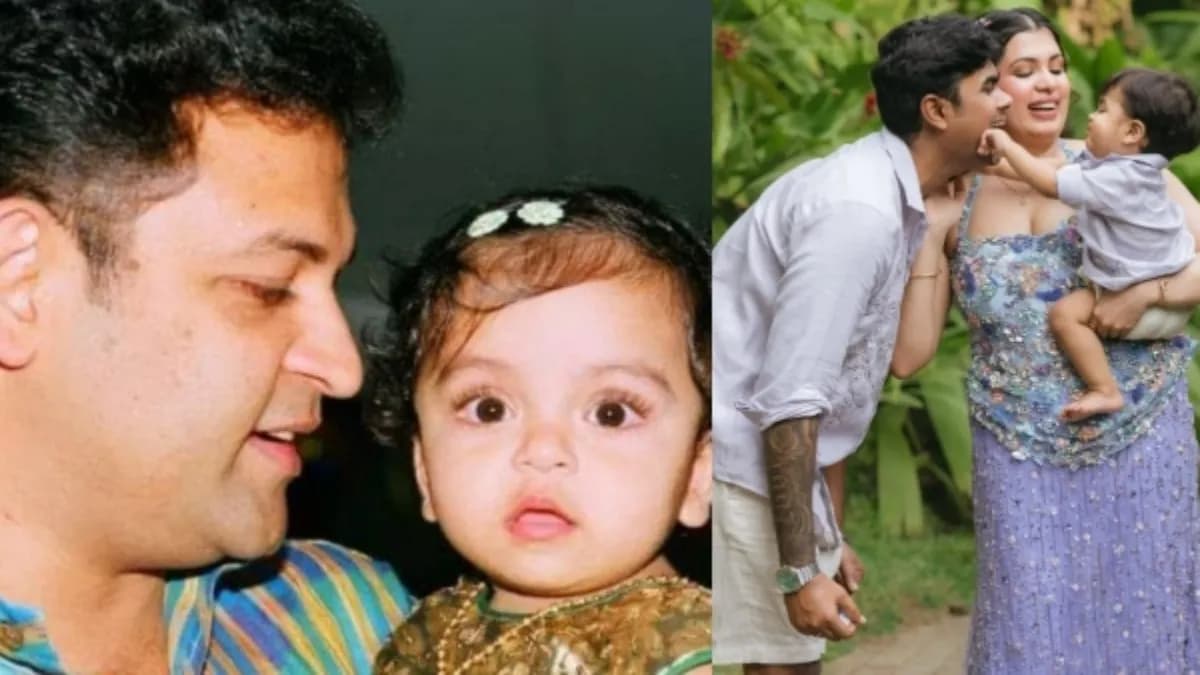
Malayalam cinema has long had a peculiar relationship with the people who shape its stories from behind the scenes - the writers whose names appear, often in modest type, in the opening frames before a single actor steps into view. This week, one of those names commanded the spotlight on its own. Krrishnakumar, the screenwriter behind several well-regarded Malayalam projects, has shared a note expressing his deep affection for a particular creative collaboration and crediting two figures - Ashwin and Osi - with solving a problem that had apparently been troubling the team. The title of his note, which translates roughly to "Something we hold very dear - Ashwin and Osi found the solution to that problem; a note from Krrishnakumar," captures both the warmth and the practicality of what appears to be a working relationship built on mutual respect. The note itself has circulated widely among Malayalam film followers, not because it announces a new project or a release date, but because it offers a rare window into the collaborative process that precedes the finished film.
The names Ashwin and Osi will be familiar to those who follow the technical and creative crews of recent Malayalam productions. Ashwin, whose full name appears in production credits across a range of projects, has built a reputation as someone who can untangle narrative knots that threaten to stall a script or a shoot. Osi, similarly, has worked in capacities that bridge the gap between the written page and the practical demands of a film set. Together, according to Krrishnakumar's account, the pair identified and resolved an issue that had resisted other attempts at a fix. The writer's decision to name them specifically, rather than folding their contribution into a general thank-you, speaks to a growing willingness in the industry to acknowledge the craft that happens away from the camera.
A Note That Says More Than It Announces
What makes Krrishnakumar's message notable is not any single revelation but the tone it strikes. In an industry where promotional cycles tend to favor hype over honesty, a writer pausing to publicly appreciate two collaborators for solving a problem carries a certain weight. It suggests that the creative process, for all its glamour, is often a grind of small breakthroughs - and that the people who deliver those breakthroughs deserve to be named. The writer's phrasing, which places the shared affection for the project at the front of the sentence before turning to the solution, implies that the attachment came first. In other words, this was not a problem worth solving because it was convenient; it was worth solving because the team cared about what they were making.
That distinction matters in an industry that produces films at a remarkable clip. Malayalam cinema has, over the past decade, earned a reputation for narrative ambition that outstrips its budgets. Writers in the language have increasingly been treated as auteurs in their own right, with their names used as selling points and their back catalogues scrutinized by streaming audiences discovering Malayalam films for the first time. In that climate, a writer's public note about a problem solved is also a signal about the standards he expects from his collaborators - and about the standards he applies to himself.
The People Behind the Fix
It is worth pausing on the roles that Ashwin and Osi play in a production. Malayalam film crews have become notably collaborative in recent years, with directors, writers, and technical heads often working in close quarters from the earliest stages of development. The traditional hierarchy, in which the writer hands over a finished script and steps away, has given way in many cases to a more fluid arrangement where problems are solved collectively. Ashwin and Osi appear to belong to that newer model - figures who can move between departments and whose value lies precisely in their ability to see the whole picture rather than a single slice of it.
Krrishnakumar's note does not specify the nature of the problem, and it would be wrong to speculate. What can be said is that the phrasing he uses suggests a genuine impasse, not a routine tweak. Writers do not usually single out colleagues for praise over minor adjustments; they do so when a project's path has been genuinely cleared. The fact that he frames the solution as something the team achieved together, while still naming Ashwin and Osi individually, reflects a balance that is harder to strike than it looks - giving credit without diminishing the collective effort.
Why This Matters to Malayalam Filmgoers
For audiences, notes like this one are a reminder that the films they watch are the product of many hands and many conversations. The Malayalam industry's recent run of critical and commercial successes has been built on exactly this kind of behind-the-scenes problem-solving, often by people whose names never appear on a poster. Krrishnakumar's willingness to put his appreciation in writing also sets a tone for how the industry talks about its own. In a field where public statements are frequently calibrated for publicity, a straightforward note of thanks stands out.
Whether this particular collaboration leads to a project already in the pipeline or one yet to be announced, the note itself has done its work. It has given credit where the writer believes credit is due, and it has reminded readers that the stories they love are shaped as much by the people who fix them as by the people who first imagine them. For Malayalam cinema, that is a familiar truth - and one worth restating.
Source: Filmibeat Malayalam