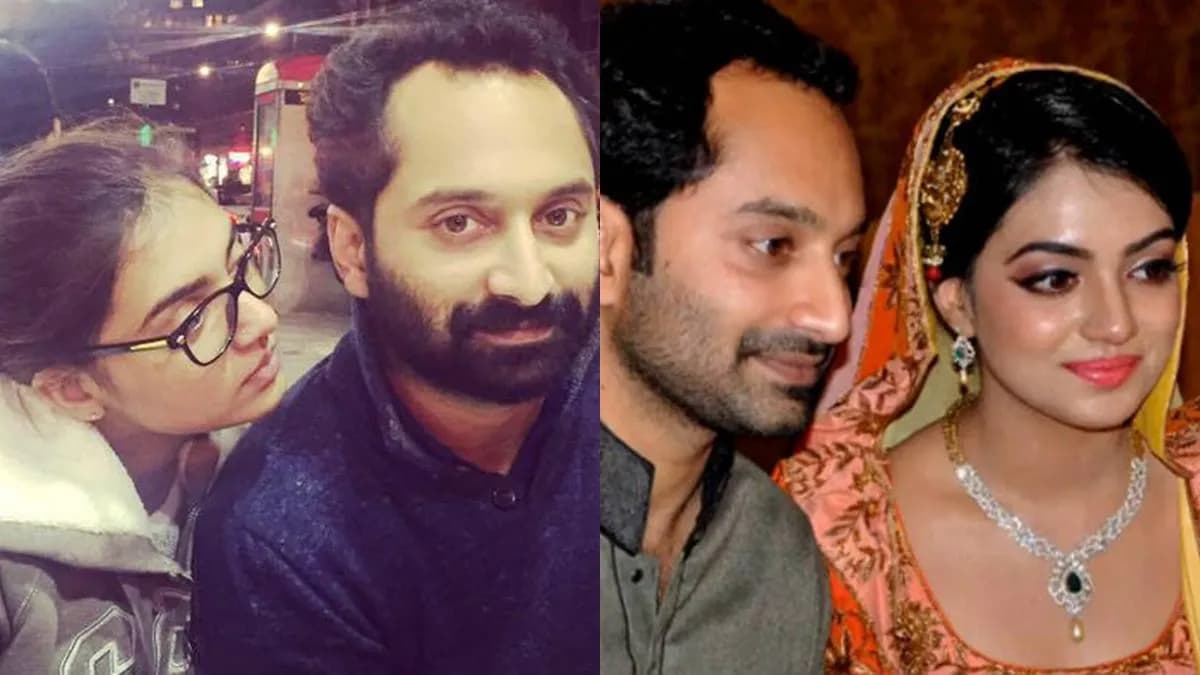
Actor Fahadh Faasil has found himself at the centre of a fresh round of public discussion in Kerala, this time not for a performance or a production announcement but for the way he entered married life. The conversation, which has been building across social media and television panel debates over recent days, centres on the widely circulated observation that the actor was never "groomed" into marriage by circumstance, family pressure or accumulated responsibility, but instead arrived at it through love. The framing has struck a chord in a state where celebrity weddings are routinely dissected through the prism of caste, community, age and professional convenience.
At the heart of the discussion is a simple contrast. Fahadh, who is now among the most sought-after performers in Malayalam cinema, married actress Nazriya Nazim in 2014, when both were at very different points in their careers. The argument now being made by commentators and fans alike is that the union was not the product of any calculated arrangement, nor of the kind of "settling down" that many in the industry describe as an inevitability once responsibilities pile up. Instead, it is being held up as an example of a love marriage that survived the scrutiny that accompanies two working actors building a life together.
Why the "Grooming" Comparison Emerged
The phrase gaining traction is that the actor was not groomed by circumstance. In the context of Malayalam cinema, that word is being used loosely to describe the informal process by which young stars are nudged toward marriage once they acquire dependents, financial obligations or the burden of managing an extended household. Several observers have pointed out that Fahadh's situation did not fit that template. He was already an established actor with a distinct identity when the relationship became public, and the decision was presented as a personal one rather than a family-directed arrangement.
This distinction matters to the audience because it changes how the marriage is read. A marriage born of obligation is usually discussed in terms of duty, adjustment and sacrifice. A marriage born of attraction and mutual choice invites a different kind of conversation - one about compatibility, partnership and the willingness to prioritise a relationship over career momentum. The current debate has leaned heavily into the second reading, with many framing it as a rare instance in which a leading man chose the relationship first and negotiated the professional consequences afterwards.
A Career That Refused a Fixed Path
Part of what makes the discussion interesting is Fahadh's own professional trajectory. He has consistently avoided the conventional leading-man mould, alternating between commercial projects and films that place him in morally complicated territory. That willingness to resist expectation off screen is now being connected, somewhat loosely, to his willingness to resist expectation on screen as well. Commentators have suggested that an actor who declines to protect a particular image is also more likely to make personal decisions without consulting the unwritten rulebook of the industry.
It is worth noting that the current chatter is not attached to any announced film. No new project has been linked to this discussion, and there has been no official statement from the actor or his representatives on the matter. The conversation is instead a retrospective one, revisiting a decision made years ago and reinterpreting it through the lens of everything that has happened since - the couple's continued presence in the public eye, the way they have handled fame, and the relatively low volume of controversy surrounding their personal life.
What the Audience Is Actually Debating
Strip away the celebrity angle and the underlying question is familiar to Malayali households. Who gets to decide whom a person marries, and how much weight should be given to family expectation, financial stability and social standing? When a public figure is seen to have chosen love over arrangement, that choice becomes a reference point in those arguments. It is a burden that falls on very few people, and Fahadh's name is now being used in that role whether he invited it or not.
There is also a quieter, more cynical reading doing the rounds. Some argue that love marriages among celebrities are simply easier to sustain because both partners operate within the same industry, share the same working hours and understand the same pressures. On this view, the romance narrative is less about courage and more about practicality. That counterargument has not gained much traction in the current cycle, but it exists, and it complicates the neat story being told.
For now, the discussion remains what it has been from the start - a public conversation about a private decision. Fahadh Faasil has not responded to the framing, and there is no indication that he intends to. The actor's next moves on screen will, as always, be what ultimately reshapes the narrative. Until then, the phrase circulating in film circles is likely to keep resurfacing, not because it reveals anything new about the man, but because it says something about how Malayalam cinema's audience still thinks about marriage, choice and the price of both.
Source: Filmibeat Malayalam