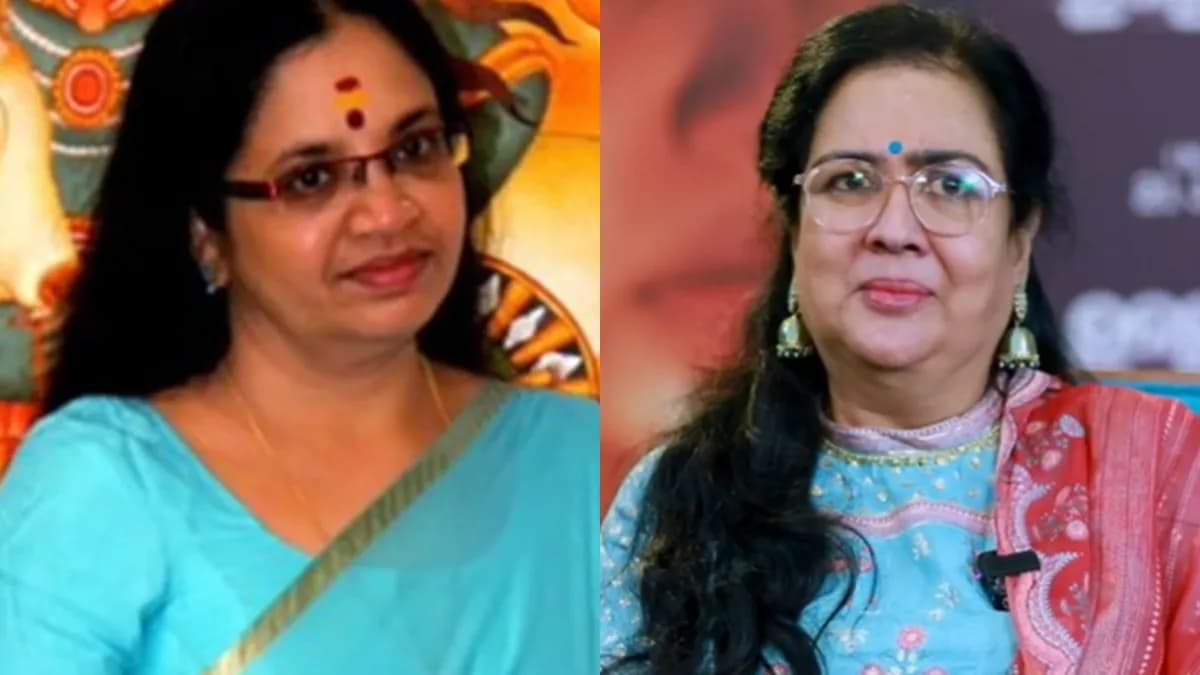
Veteran Malayalam actress Urvashi has found herself at the center of a fresh controversy, but this time the criticism is coming not from a reviewer or a fan, but from a fellow actor. Bhagyalakshmi, known for her work in Malayalam and Tamil cinema, has taken a pointed swipe at Urvashi over what she claims is an inappropriate dubbing choice, while simultaneously expressing admiration for rising star Vismaya.
The dispute appears to have originated from a recent dubbing session, though the specific project remains unconfirmed. Bhagyalakshmi, who has built a reputation for speaking her mind, did not hold back in her assessment. Speaking to the media, she questioned the logic behind whoever handled the dubbing for Urvashi's character, suggesting that the mismatch between voice and screen presence was glaring enough to draw notice.
"I don't know who did the dubbing, and I feel sorry for them," Bhagyalakshmi said, according to reports. Her tone suggested a mix of bewilderment and sympathy, as if the voice artist had been handed an impossible task. The remark has since sparked debate among Malayalam film enthusiasts, many of whom are now speculating about which recent release or upcoming project triggered the observation.
What makes this exchange particularly interesting is the contrast Bhagyalakshmi drew with Vismaya, the young actress who has been making waves in the industry. Bhagyalakshmi made it clear that her frustration was not with the craft of dubbing itself, but with the way it was deployed in this specific instance. When it came to Vismaya, however, her tone shifted to one of genuine respect.
"With Vismaya, I feel a sense of respect," Bhagyalakshmi remarked, praising the younger performer's ability to carry her roles with conviction. The juxtaposition was stark: pity for whoever voiced Urvashi's part, admiration for Vismaya's approach to her work. It is unclear whether Vismaya and Urvashi appeared in the same production, or whether Bhagyalakshmi was simply contrasting two different working styles she had recently observed.
Urvashi, a National Film Award winner with a career spanning over four decades, is no stranger to public scrutiny. She has navigated the industry through multiple generations of filmmakers and has often been praised for her naturalistic performances. Dubbing, in her case, has occasionally been handled by other artists due to scheduling conflicts or vocal strain, a common practice in Indian cinema where post-production timelines are tight.
The practice of dubbing is deeply embedded in Malayalam cinema, though its necessity is often questioned by purists. In many cases, actors who are not native speakers of the language, or those whose voices do not match the physicality of a role, are dubbed over by professional artists. However, when an established actor like Urvashi is involved, audiences tend to expect her own voice, making any substitution a topic of intense discussion.
Bhagyalakshmi's comments have reopened that conversation. Her phrasing, which leaned toward the sympathetic rather than the accusatory, suggests that she holds the unseen dubbing artist in higher regard than the decision-makers who approved the take. By saying the person deserves pity, she implied that the blame lies higher up the chain, possibly with directors or producers who failed to recognize the mismatch.
The response from Urvashi's camp has been muted so far. There has been no official statement from the actress or her representatives, which is typical of her approach to controversies. Over the years, Urvashi has preferred to let her work speak for itself, rarely engaging in public spats or media wars. Whether she will break that silence this time remains to be seen.
Industry insiders, however, are reading Bhagyalakshmi's comments as more than just a stray remark. Some suggest it could be a reflection of growing tensions within certain production circles, where voice artists are often undervalued despite playing a crucial role in a film's success. Others believe it is simply a case of one actor critiquing a technical lapse without any underlying animosity.
For Vismaya, the praise from Bhagyalakshmi adds to a growing list of endorsements from senior actors. The young performer has been steadily climbing the ranks, delivering performances that have caught the attention of both critics and audiences. Being singled out in the same breath as a veteran like Urvashi, even if the context was critical of the latter's dubbing, could prove beneficial for her career trajectory.
What remains unresolved is the identity of the project in question. With no official confirmation from any production house, fans are left to speculate. Some have pointed to recent theatrical releases that featured Urvashi in supporting roles, while others suggest the comment may relate to a web series or a television venture. The ambiguity has only fueled the online chatter.
In the broader scheme of things, this episode highlights how dubbing continues to be a sensitive subject in Malayalam cinema. It is a technical craft that can elevate or undermine a performance, yet it rarely gets the spotlight. Bhagyalakshmi's remarks, regardless of their intent, have thrust it into the foreground, forcing a conversation about quality control and artistic integrity.
For now, the ball is in Urvashi's court. Whether she chooses to respond, clarify, or simply move on will likely shape the next cycle of this story. But one thing is certain: in an industry where every word is dissected, Bhagyalakshmi has ensured that this particular dubbing debate will not fade quietly into the background.
Source: Filmibeat Malayalam