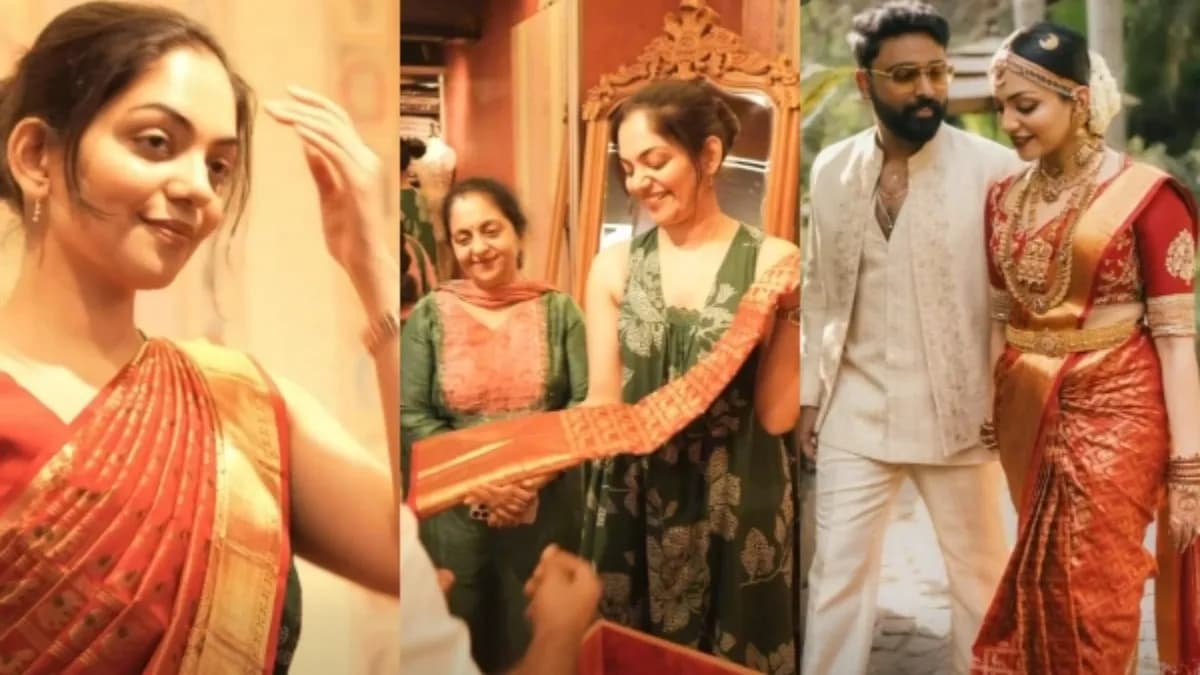
A wedding saree, in Malayalam cinema, is rarely just a wedding saree. It is a promise, a lineage, a piece of armour. And in the hands of Ahana, it becomes something else entirely - a weapon of the divine. The young actor's upcoming film has been generating steady conversation ever since its first look suggested a heroine caught between two very different manifestations of the goddess: the gentle abundance of Lakshmi and the burning fury of Durga. The premise is simple on paper and considerably more complicated on screen. A woman who carries the serenity of the goddess of prosperity must, when her family is threatened, summon the fearsome strength of the goddess who rides a lion.
That transformation appears to be the emotional spine of the film, and it is the reason the project has moved beyond the usual chatter around a star vehicle. Malayalam audiences have grown increasingly receptive to narratives that fold mythology into domestic life without turning either into decoration. Here, the two registers sit side by side by design. The Lakshmi aspect is not a costume the heroine wears for a song sequence; it is the life she has built - the household she holds together, the calm she maintains, the quiet authority with which she moves through a world that expects her to be ornamental. The Durga aspect is what waits underneath, dormant until the moment protection becomes inseparable from violence.
A Saree That Carries the Weight of a Turning Point
Much of the early interest has centred on the wedding saree, and the reason is not purely aesthetic. In the film's visual grammar, the saree appears to function as the hinge on which the character turns. It is associated with the most conventional image of a Malayali bride - draped, adorned, escorted, expected to be soft. The film seems to use that association deliberately, then dismantles it. The same garment that marks her entry into married life becomes the thing she wears when she stops being merely a daughter, a wife, or a daughter-in-law, and starts being a defender.
This is familiar territory for anyone who has followed the way Malayalam filmmakers have reworked the mythological heroine over the past decade. The Devi figure has been reclaimed repeatedly - sometimes as a political metaphor, sometimes as a straight-up action engine, sometimes as a study in exhaustion. What distinguishes this project, at least from what has been revealed so far, is the refusal to treat the transition as a single cathartic moment. The Lakshmi-to-Durga arc is presented as something closer to a continuum, where the fury is not a departure from the prosperity but its logical extension. A family is, after all, a form of wealth. To guard it is to guard Lakshmi. To fail at guarding it is to invite the kind of rage that scripture reserves for Durga.
Ahana's casting adds another layer. She has spent much of her career in roles that leaned on warmth and relatability, and this film asks her to hold both registers in the same body. The challenge is not the action choreography, which Malayalam cinema has become increasingly adept at staging for women. The challenge is making the audience believe that the calm was never passivity in the first place - that the woman who folds her hands before the lamp is the same woman who will pick up something considerably heavier.
The Larger Conversation the Film Walks Into
It would be easy to reduce the film to a single line about a bride who becomes a goddess to save her people, and the marketing has understandably leaned on that image. But the more interesting current running beneath it concerns the way Malayalam cinema keeps returning to the Devi myth as a way of talking about women's anger. The anger is rarely permitted to be simple. It has to be justified by threat, sanctified by family, framed by devotion. Audiences have become alert to that framing, and the films that succeed are the ones that acknowledge the bargain rather than pretending it doesn't exist.
Whether this film clears that bar will be evident only when it reaches theatres, and no release window or box-office projection is available at this stage. What can be said is that the material has the ingredients that have worked before: a recognisable star in a role that stretches her, a mythological framework audiences already carry in their heads, and a central image - the saree - that is both deeply traditional and primed for subversion. The question is whether the film treats the duality as a genuine argument or merely as a spectacle to be mounted for a climactic stretch.
For now, the conversation around the film is doing what the best early buzz does: it is asking audiences what they think the image means before they have seen a frame of it in motion. A woman who looks like Lakshmi and fights like Durga is not a contradiction in Malayalam storytelling. She is an old idea, dressed in a new saree, waiting to see whether anyone will mistake her stillness for surrender.
Source: Filmibeat Malayalam