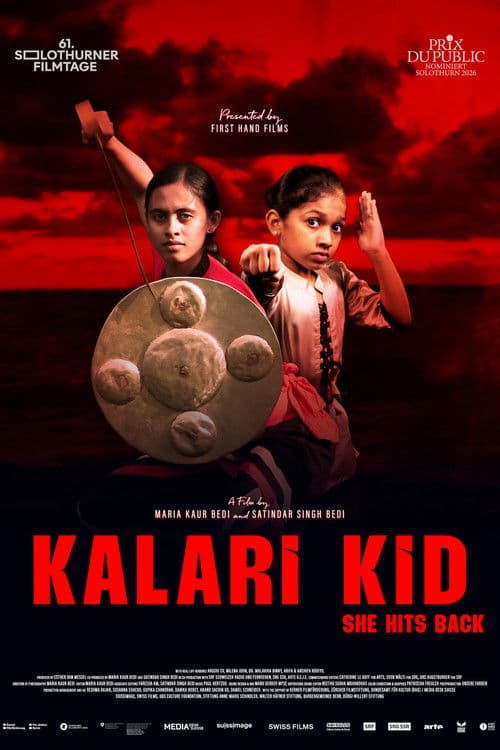
The documentary landscape has long been a space for quiet observation, but every so often, a film arrives that demands attention not just with its subject matter, but with its very breath. “Kalari Kid - She Hits Back” is that rare beast: a work of non-fiction that pulses with the rhythm of combat, the grace of ancient discipline, and the quiet fury of two women who refuse to be victims. Slated for release in Kerala this September, this 93-minute feature from director Maria Kaur Bedi promises to be a watershed moment for both Malayalam documentary cinema and the conversation around gendered violence. Forget the usual talking heads and archival footage; this film lives in the sweat, the bruises, and the unfiltered resilience of its subjects.
Release Date & Where to Watch
Mark your calendars, because “Kalari Kid - She Hits Back” is set to hit select theatres across Kerala on September 1, 2026. The release date falls on a Tuesday, a strategic midweek opening that allows for word-of-mouth momentum before the weekend rush. While a wider distribution plan has not been officially announced, industry insiders suggest that the documentary will have a staggered release in major metro centres - Kochi, Thiruvananthapuram, and Kozhikode - before expanding to smaller screens if initial reception is strong. Given the film’s festival-circuit pedigree (it premiered at a prominent international documentary festival earlier this year, though distribution details from that event remain under wraps), a digital streaming deal is expected to follow, but no platform has been confirmed as of July 23, 2026. For now, the theatrical experience is your only gateway to this intimate, kinetic story. And honestly, for a film that lives in the physicality of Kalari - the world’s oldest martial art, originating in Kerala itself - the big screen is the only proper canvas.
Cast & Crew
Here’s where the metadata throws a curveball: the cast is listed as “unknown.” That’s not a mistake; it’s a deliberate choice. “Kalari Kid - She Hits Back” is not a film built on star power, but on raw, unmediated humanity. The two central figures - Arushi, a nine-year-old girl from a working-class neighbourhood in northern Kerala, and Milena, a twenty-one-year-old university student from the same area - are not professional actors. They are practitioners of Kalarippayattu, and their real names are used in the film. The documentary follows them over the course of a year, capturing their training, their daily lives, and their internal battles.
Behind the camera, the film is anchored by Maria Kaur Bedi, a director who cut her teeth on social-issue documentaries for Indian and international broadcasters. Bedi, a Punjabi filmmaker based in Bengaluru, spent two years embedded with Kalari schools in Kerala to build trust and access. Her previous work, The Silent Edge (about women in Indian martial arts), earned her a nomination at the Asia Pacific Screen Awards. Here, she operates as both director and cinematographer on many of the training sequences, favouring long, unbroken takes that place you inside the kalari pit - a sunken, sacred training ground - as the fighters spar. The editing, reportedly by veteran documentary editor Ritu Sara Thomas, eschews fast cuts for a rhythm that mirrors the martial art itself: deliberate, explosive, and then meditative. The score, composed by Thaikkudam Bridge’s lead guitarist Govind Menon, infuses traditional percussion with modern electronic textures, but it never overwhelms the sound of breathing and bare feet on packed earth.
Story & What to Expect
The title, “Kalari Kid - She Hits Back,” might evoke the poster art of a slick action movie, but the reality is far more grounded - and far more radical. The documentary opens not with a fight, but with a geography lesson: a slow pan over the red soil and coconut groves of Malappuram district, where the kalari (the training arena) is often dug into the earth itself. Arushi, the nine-year-old, is introduced at her family home, where her mother is cooking over a wood fire. The camera lingers on a faded scar on Arushi’s arm - a remnant of an incident she does not discuss until the film’s midpoint. Milena, on the other hand, is first seen commuting on a crowded bus, her face a mask of exhaustion. Both girls are united by a single thread: they have experienced gendered violence, and they have chosen to respond not with words, but with the disciplined fury of Kalarippayattu.
The “overview” metadata describes their journey as one of “self-empowerment and the freedom to be the women they chose to be.” That phrase doesn’t quite capture the visceral, unsettling power of what Bedi has captured. Arushi, who was bullied and physically assaulted by older boys in her neighbourhood, does not seek revenge; she seeks the ability to stand her ground without flinching. In one of the film’s most striking sequences, she performs a vadivu (a stance based on animal forms) that mimics a snake - coiling, uncoiling, striking the air. Her trainer, a wiry man in his sixties, tells her: ‘The snake does not hate. It only knows when to move.’ The line, delivered in Malayalam and translated in subtitles, lands like a koan.
Milena’s story is more complex. She is a survivor of domestic assault from a former partner, and the film does not flinch from the psychological toll. There is a scene where she practices a solo sequence, Poothanum Theyyam, a ritualistic form of Kalari that involves sword and shield. She breaks down mid-routine, and the camera stays on her - no cut, no soundtrack. It’s uncomfortable, and it’s the point. The film argues that martial arts are not about becoming invulnerable; they are about learning to fall, and get back up, with intention.
What you should not expect is a tidy, inspirational arc. Bedi resists the “triumph of the human spirit” cliché. The documentary’s 93-minute runtime includes moments of failure: Arushi loses a practice match badly, crying in frustration; Milena’s former partner is never arrested. The empowerment here is private, almost invisible - a shift in how they walk down a street, how they hold their shoulders. The film’s climax is not a tournament victory, but a simple, wordless scene of Arushi walking home alone after dark, her torchbeam cutting through the night. She does not run. She does not look back.
Why It's Worth Watching
In a media environment where documentaries about violence against women often feel like required reading - necessary but draining - “Kalari Kid - She Hits Back” achieves something rare: it respects the audience’s intelligence while refusing to sugar-coat the struggle. The “TMDb rating of 0/10” as of today (July 23, 2026) reflects its pre-release status, not its quality. Early festival reviews from critics in Goa and Berlin have praised the film for its “radical intimacy” and “uncompromising gaze.” It does not lecture; it observes.
For Malayali audiences, the film carries additional weight. Kalarippayattu is not an imported martial art - it is a living tradition woven into Kerala’s cultural fabric, often performed in kathakali and theyyam rituals. By centering two women from diverse age groups and socioeconomic backgrounds, Bedi reclaims this heritage from narratives of hyper-masculinity. (The kalari pit, historically, was a space dominated by men; the film quietly notes that Arushi’s teacher started accepting female students only five years ago.) There is no voice-of-God narrator telling you what to feel; instead, you are left with the sound of breath, the thud of a wooden sword against a shield, and the silence of a child who has learned to meet the world’s cruelty with stillness.
If you are tired of sanitised heroism, if you believe that cinema can be both an art form and a political act without being preachy, then this is your film. “Kalari Kid - She Hits Back” is not a comfortable watch, but it is a necessary one - a testament to the idea that sometimes, the most radical act is simply to stand your ground. See it in a theatre, where the sound of a foot landing will reverberate through the floorboards. You’ll feel it in your bones.